Today On The Eric Metaxas Show, Eric talks with Roger Kimball about New York City, Islam, and why they argue the West is losing civilizational confidence. They discuss whether the Islam vs Islamism distinction holds up, why assimilation and shared values matter for a free society, and what is happening in Europe and England right now. Then they pivot to Iran, regime change predictions, and why they believe Trump is reshaping the global order from the border to energy to foreign policy.
-
How Political Correctness Hijacked the Arts | Roger Kimball and Heather MacDonald

What gets to be called art — and who decides? In this wide-ranging Socrates Dialogues conversation, New York–based thinkers, writers, and art admirers Heather Mac Donald and Roger Kimball explore the definition of art and the history of the unmaking of beauty in modern contemporary art. Drawing on examples from Duchamp, Warhol, Serrano, Hirst, and others, the two discuss how the banal, the transgressive, and the political have reshaped the aesthetic experience of art, often robbing it of spiritual resonance.
-
Populism, X: The Imperative of Freedom
It is curious how certain words accumulate a nimbus of positive associations while others, semantically just as innocuous, wind up shouldering a portfolio of bad feelings.
Consider the different careers of the terms “democracy” and “populism.”
Do you know any responsible person who would admit to being opposed to democracy? No one who does not enjoy a large private income would risk it. But lots of people are willing to declare themselves anti-populist. The discrepancy is curious for several reasons.
It was not at all clear, Madison thought, that democracy was a reliable custodian of liberty.
For one thing, it is a testament to the almost Darwinian hardiness of the word “democracy.” In the fierce struggle among ideas for survival, “democracy” has not only survived but thrived. This is despite the fact that political thinkers from Plato and Aristotle through Cicero and down to modern times have been deeply suspicious of democracy. Aristotle thought democracy the worst form of government, all but inevitably leading to ochlocracy or mob rule, which is no rule.
In Federalist 10, James Madison famously warned that history had shown that democratic regimes have “in general been as short in their lives as they have been violent in their deaths.” “Theoretic politicians,” he wrote—and it would be hard to find a more contemptuous deployment of the word “theoretic”—such politicians may have advocated democracy, but that is only because of their dangerous and utopian ignorance of human nature. It was not at all clear, Madison thought, that democracy was a reliable custodian of liberty.
Nevertheless, nearly everyone wants to associate himself with the word “democracy.” Totalitarian regimes like to describe themselves as the “Democratic Republic” of wherever. Conservatives champion the advantages of “democratic capitalism.” Central planners of all stripes eagerly deploy programs advertised as enhancing or extending “democracy.” Even James Madison came down on the side of a subspecies of democracy, one filtered through the modulating influence of a large, diverse population and an elaborate scheme of representation that softened (Madison said “excluded”) the influence of “the people in their collective capacity.”
“Democracy,” in short, is a eulogistic word, what the practical philosopher Stephen Potter in another context apostrophized as an “OK word.” And it is worth noting, as Potter would have been quick to remind us, that the people pronouncing those eulogies delight in advertising themselves as, and are generally accepted as, “OK people.” Indeed, the class element and the element of moral approbation—of what some genius has summarized as “virtue signaling”—are key.
It is quite otherwise with “populism.” At first blush, this seems odd because the word “populism” occupies a semantic space closely adjacent to “democracy.” “Democracy” means “rule by the demos,” the people. “Populism,” according to The American Heritage Dictionary, describes “A political philosophy directed to the needs of the common people and advancing a more equitable distribution of wealth and power”— that is, just the sorts of things that the people, were they to rule, would seek.
But the fact is that “populism” is ambivalent at best. Sometimes, it is true, a charismatic figure can survive and even illuminate the label “populist” like a personal halo. Bernie Sanders managed this trick among the eco-conscious, racially omnivorous, non-gender-stereotyping, anti-capitalist beneficiaries of capitalism who made up his core constituency.
But it was always my impression that in this case the term “populist” was fielded less by Sanders or his followers than by his rivals and the media in an effort to fix him in the public’s mind as one of the many lamentable examples of not-Hillary, who herself was presumed to be popular though not populist.
There are at least two sides to the negative association under which the term “populist” struggles. On the one hand, there is the issue of demagoguery. Some commentators tell us that “populist” and “demagogue” are essentially synonyms (though they rarely point out that demagogos simply meant “a popular leader,” e.g., Pericles). The association of demagoguery and populism describes what we might call the command-and-control aspect of populism. The populist leader is said to forsake reason and moderation in order to stir the dark, chthonic passions of a semi-literate and spiritually unelevated populace.
On the other hand, there is the issue of the fertile but unedifying soil of that populace upon which the demagogic leader works. Anyone who has looked at the commentary on Brexit, the campaign and early months of the Trump administration, or the recent French election will have noted this.
Consider, to take but one example, how often the word “anger” and its cognates are deployed to evoke the psychological and moral failings of both the populist multitude and its putative leaders. In a remarkable, apocalyptic effusion published in the early hours of November 9, 2016, David Remnick, the editor of The New Yorker, warned that the Trump presidency represented “a rebellion against liberalism itself,” an “angry assault” on the civil rights of women, blacks, immigrants, homosexuals, and countless others. Later commentators warned about our “angry, cynical times,” the “raw, angry and aggrieved” tone of Trump’s rhetoric, the unchaperoned “anger” of Americans who felt they “had been left behind.” “Trump’s Anger Could Lead Down a Dangerous Road,” quoth cnn. “Inside Trump’s Anger and Impatience—and His Sudden Decision to Fire Comey,” The Washington Post. “How Festering Anger at Comey Ended in His Firing,” The New York Times.
There are occasional acknowledgments that the diagnosed “anger” may be understandable, even justified. But we are left with the unmistakeable impression that the phenomenon as a whole is something vicious and irrational. Anger “festers.” It leads to “sudden,” i.e., impulsive decisions. The road it steers us toward could be “dangerous.” (Ah, how cheap is possibility: when we read that “could be” dangerous, do we also think, as we should, that it might just as well not be?)
Populism seems incapable of escaping the association with demagoguery and moral darkness. Like the foul-smelling wounds of Philoctetes, the stench is apparently incurable. Granted, there are plenty of historical reasons for the association between demagoguery and populism, as such names as the brothers Tiberius and Gaius Gracchus, Father Coughlin, and Huey Long remind us.
Populism seems incapable of escaping the association with demagoguery and moral darkness.
Still, I suspect that in the present context the apparently unbreakable association between populism and demagoguery has less to do with any natural affinity than with cunning rhetorical weaponization. “Populism,” that is to say, is wielded less as a descriptive than as a delegitimizing term. Successfully charge someone with populist sympathies and you get, free and for nothing, both the imputation of demagoguery and what was famously derided as a “deplorable” and “irredeemable” cohort. The element of existential depreciation is almost palpable.
So is the element of condescension. Inseparable from the diagnosis of populism is the implication not just of incompetence but also of a crudity that is part aesthetic and part moral. Hence the curiously visceral distaste expressed by elite opinion for signs of populist sympathy. When Hillary Clinton charged that half of Donald Trump’s supporters were an “irredeemable” “basket of deplorables,” when Barack Obama castigated small-town Republican voters as “bitter” folk who “cling to guns or religion or antipathy to people who aren’t like them or anti-immigrant sentiment or anti-trade sentiment,” what they expressed was not disagreement but condescending revulsion.
Ithink I first became aware that the charge of populist sympathies could have a powerful political, moral, and class delegitimizing effect when I was in London last June to cover the Brexit vote. Nearly everyone I met, from Tory ministers to taxi drivers, from tourists to tradesmen, was a Remainer. The higher up the income and class scale you went, the more likely it was that your interlocutor would be in favor of Britain’s remaining in the European Union. And the more pointed would be his disparagement of those arguing in favor of Brexit. The Brexiteers were said to be “angry,” yes, but also ignorant, fearful, xenophobic, and racist.
Except that they weren’t, not the ones I met, anyway. For them, Brexit turned on a simple question: “Who rules?” Is the ultimate source of British sovereignty Parliament, as had been the case for centuries? Or is it Brussels, seat of the European Union?
The question of sovereignty, I believe, takes us to the heart of what in recent years has been touted and tarred as the populist project.
Consider Britain. Parliament answers to the British voters. The European Union answers to—well, to itself. Indeed, it is worth pausing to remind ourselves how profoundly undemocratic is the European Union. Its commissioners are appointed, not elected. They cannot be turned out of office by voters. If the public votes contrary to the wishes of the E.U.’s commissars in a referendum, they are simply presented with another referendum until they vote the “right” way. The E.U.’s financial books have never been subject to a public audit. The corruption is just too widespread. Yet the E.U.’s agents wield extraordinary power over the everyday lives of their charges. A commissioner in Brussels can tell a property owner in Wales what sort of potatoes he may plant on his farm, how he must calculate the weight of the products he sells, and whom he must allow into his country. He can outlaw “racism” and “xenophobia”—defined as harboring “an aversion” to people based on “race, colour, descent, religion or belief, national or ethnic origin” and specify a penalty of “at least” two years’ imprisonment for infractions. He can “lawfully suppress,” as the London Telegraph reported, “political criticism of its institutions and of leading figures,” thus rendering the commissars of the E.U. not only beyond the vote but also beyond criticism.
It’s a little different in the United States. I’ll come to that below. At the moment, it is worth noting to what extent the metabolism of this political dispensation was anticipated by Alexis de Tocqueville in his famous passages about “democratic despotism” in Democracy in America. Unlike despotism of yore, Tocqueville noted, this modern allotrope does not tyrannize over man—it infantilizes him. And it does this by promulgating ever more cumbersome rules and regulations that reach into the interstices of everyday life to hamper initiative, stymie independence, stifle originality, homogenize individuality. This power, said Tocqueville, “extends its arms over society as a whole.”
It does not break wills, but it softens them, bends them, and directs them; it rarely forces one to act, but it constantly opposes itself to one’s acting; it does not destroy, it prevents things from being born; it does not tyrannize, it hinders, compromises, enervates, extinguishes, dazes, and finally reduces each nation to being nothing more than a herd of timid and industrious animals of which the government is the shepherd.
Tocqueville’s analysis has led many observers to conclude that the villain in this drama is the state. But the political philosopher James Burnham, writing in the early 1940s in The Managerial Revolution, saw that the real villain was not the state as such but the bureaucracy that maintained and managed it. It is easy to mock the apparatchiks who populate the machinery of government. Thus James H. Boren writes wickedly that “the noblest of all of man’s struggles are those in which dedicated bureaucrats, armed with the spirit of dynamic inaction, have fought to protect the ramparts of creative nonresponsiveness from the onslaughts of mere citizens who have demanded action in their behalf.” But the comic potential of the morass should not blind us to the minatory nature of the phenomenon. Indeed, it presents a specimen case of the general truth that the preposterous and the malevolent often co-mingle. The shepherd of which Tocqueville wrote was really a flock of shepherds, a coterie of managers who, in the guise of doing the state’s business, prosecuted their own advantage and gradually became a self-perpetuating elite that arrogated to itself power over the levers of society.
Anatomizing this sleight-of-hand is at the center of “James Burnham’s Managerial Elite,” Julius Krein’s essay in the inaugural issue of American Affairs. “Although the managerial elite uses the state as an instrument to acquire power,” Krein notes, “the real enemy is not the state but rather the managerial separation of political and economic power from the liberal social contract.”
This separation of the real power of society from the economy and political life renders the managerial elite all but untouchable. And this, as Burnham saw, was the property neither of liberalism nor of conservatism but rather of anterior forces that engulfed both. “The contradiction of contemporary conservatism,” Krein writes,
is that it is an attempt to restore the culture and politics of bourgeois capitalism while accelerating the economy of managerialism. Because of its failure to recognize this contradiction, “much of conservative doctrine is, if not quite bankrupt, more and more obviously obsolescent,” as Burnham wrote in 1972. Since then it has only evolved from obsolescent to counterproductive. At this point, expanding “free markets” no longer has anything to do with classical American capitalism. It is simply the further emancipation of the managerial elite from any obligations to the political community. Likewise, promoting democracy as an abstract, universalist principle only undermines the sovereignty of the American people by rejecting national interests as a legitimate ground of foreign policy.
Sovereignty, Burnham saw, was shifting from Parliaments to what he called “administrative bureaus,” which increasingly are the seats of real power and, as such, “proclaim the rules, make the laws, issue the decrees.” As far back as the early 1940s, Burnham could write that “ ‘Laws’ today in the United States . . . are not being made any longer by Congress, but by the nlrb, sec, icc, aaa, tva, ftc, fcc, the Office of Production Management (what a revealing title!), and the other leading ‘executive agencies.’ ” And note that Burnham wrote decades before the advent of the epa, hud, cfpb, fsoc, the Department of Education, and the rest of the administrative alphabet soup that governs us in the United States today.
Iam convinced that the issue of sovereignty, of what we might call the location of sovereignty, has played a large role in the rise of the phenomenon we describe as “populism” in the United States as well as Europe. For one thing, the question of sovereignty, of who governs, stands behind the rebellion against the political correctness and moral meddlesomeness that are such conspicuous and disfiguring features of our increasingly bureaucratic society. The smothering, Tocquevillian blanket of regulatory excess has had a wide range of practical and economic effects, stifling entrepreneurship and making any sort of productive innovation difficult.
A reassertion of independence.
But perhaps its deepest effects are spiritual or psychological. The many assaults against free speech on college campuses, the demand for “safe spaces” and “trigger warnings” against verbal or fashion-inspired “micro-aggressions” (Mexican hats, “offensive” Halloween costumes, etc.) are part of this dictatorship of political correctness. In The Road to Serfdom, Friedrich Hayek said that one of the “main points” of his argument concerned “the psychological change,” the “alteration of the character of the people,” that extensive government control brought in its wake. The alteration involves a process of softening, enervation, infantilization even: an exchange of the challenges of liberty and self-reliance—the challenges, that is to say, of adulthood—for the coddling pleasures of dependence. Max Weber spoke in this context of “Ordnungsmenschen,” men who had become increasingly dependent on an order imposed upon them from above. Breaking with that drift becomes more and more difficult the more habituated to dependence a people becomes. In this sense, what has been described as a populist upsurge against political correctness is simply a reassertion of independence, a reclamation of what turns out to be a most uncommon virtue, common sense.
The issue of sovereignty also stands behind the debate over immigration: indeed, is any issue more central to the question Who governs? than who gets to decide a nation’s borders and how a country defines its first person plural: the “We” that makes us who we are as a people?
Throughout his campaign, Donald Trump promised to enforce America’s immigration laws, to end so-called “sanctuary cities,” which advertise themselves as safe havens for illegal aliens (though of course they do not call them “illegal aliens”), and to sharpen vetting procedures for people wishing to immigrate to America from countries known as sponsors of terrorism.
The President sometimes overstated and not infrequently misstated his case. Semantic precision is not a Trumpian speciality. But political effectiveness may be. Behind the Sturm und Drang that greeted Trump’s rhetoric on immigration, we can glimpse two very different concepts of the nation state and world order. One view sees the world as a collection of independent sovereign countries that, although interacting with one another, regard the care, safety, and prosperity of their own citizens as their first obligation. This is the traditional view of the nation state. It is also Donald Trump’s view. It is what licenses his talk of putting “America First,” a concept that, pace the anti-Trump media, has nothing to do with Charles Lindbergh’s isolationist movement of the late 1930s and everything to do with fostering a healthy sense of national identity and purpose.
The alternative view regards the nation state with suspicion as an atavistic form of political and social organization. The nation state might still be a practical necessity, but, the argument goes, it is a regrettable necessity inasmuch as it retards mankind’s emancipation from the parochial bonds of place and local allegiance. Ideally, according to this view, we are citizens of the world, not particular countries, and our fundamental obligation is to all mankind.
This is the progressive view. It has many progenitors and antecedents. But none is more influential than “Perpetual Peace: A Philosophical Sketch,” a brief essay that Immanuel Kant published in 1795 when he was seventy-one. The burden of the essay is to ask how perpetual peace might be obtained among states. The natural condition of mankind, Kant acknowledges, is war. But with the advent of “enlightened concepts of statecraft,” mankind, he suggests, may be able to transcend that unfortunate habit of making war and live in perpetual (ewigen) comity.
Kant lists various conditions for the initial establishment of peace—the eventual abolition of standing armies, for example—and a few conditions for its perpetuation: the extension of “universal hospitality” by nations was something that caught my eye. Ditto “world citizenship.” “The idea of . . . world citizenship,” he says at the end of the essay, “is no high-flown or exaggerated notion. It is a supplement to the unwritten code of the civil and international law, indispensable for the maintenance of the public human rights and hence also of perpetual peace.”
It is one thing to declare war illegal; it is quite another to enforce that edict.
Kant makes many observations along the way that will be balm to progressive hearts. He is against “the accumulation of treasure,” for example, because wealth is “a hindrance to perpetual peace.” By the same token, he believes that forbidding the system of international credit that the British empire employed “must be a preliminary article of perpetual peace.” Credit can be deployed to increase wealth, ergo it is suspect. Kant says that all states must be “republican” in organization. By that he means not that they must be democracies but only that the executive and legislative functions of the state be distinguished. (Indeed, he says that democracy, “properly speaking,” is “necessarily a despotism” because in it the executive and legislative functions of governments are both vested in one entity, “the people.”) He looks forward to the establishment of a “league of nations” (Völkerbund), all of which would freely embrace a republican form of government.
It would be hard to overstate the influence of Kant’s essay. It stands behind such progressive exfoliations as Woodrow Wilson’s “Fourteen Points,” not least the final point that looked forward to the establishment of a League of Nations. You can feel its pulse beating in the singing phrases of the 1928 Kellogg-Briand Pact, which outlawed war. It is worth noting that among the initial fifteen signatories of that noble-sounding pact, along with the United States, France, and England, were Germany, Italy, and Japan. What does that tell us about the folly of trusting paper proclamations not backed up by the authority of physical force? It is one thing to declare war illegal; it is quite another to enforce that edict.
Kant’s essay also directly inspired the architects of the United Nations and, in our own day, the architects of the European Union and the battalions of transnational progressives who jettison democracy for the sake of a more-or-less nebulous (but not therefore un-coercive) ideal of world citizenship.
I would not care to wager on how many of the hysterics who congregated at airports across the country to protest Donald Trump’s effort to make the citizens of this country safer were students of Kant. Doubtless very few. But all were his unwitting heirs. “Universal hospitality”: how the protestors would have liked that! (Though to be fair to Kant, he did note that such hospitality “is not the right to be a permanent visitor.”) I have no doubt that the motivation of the protestors had many sources. But to the extent that it was based on a political ideal (and not just partisan posturing or a grubby bid for notoriety and power), the spirit of Kant was hovering there in the background.
Kant was not without a sense of humor. He begins his essay by noting that he took his title from a sign outside a Dutch pub. “Pax Perpetua” read the sign, and below the lettering was the image of a graveyard. Perhaps the universal perpetuity of death is the only peace that mankind may really look forward to. Kant clearly wouldn’t agree, but it was charming of him to acknowledge that the idea of a genuine perpetual peace for mankind might be regarded by many as nothing more than a “sweet dream” of philosophers.
What has been called the populist spirit aims to rouse us from that “sweet dream”—what James Madison might have called the “theoretic” reverie of the meddling class whose designs for our salvation always seem to involve the extension of their own power and prerogative. In this sense, the issue of sovereignty also stands behind the debates over the relative advantages and moral weather of “globalism” vs. “nationalism”—a pair of terms almost as fraught as “democracy” and “populism”—as well as the correlative economic issues of underemployment and wage stagnation. “Theoretic” politicians may advocate “globalism” as a necessary condition for free trade. But the spirit of local control tempers the cosmopolitan project of a borderless world with a recognition that the nation state has been the best guarantor not only of sovereignty but also of broadly shared prosperity. What we might call the ideology of free trade—the globalist aspiration to transcend the impediments of national identity and control—is an abstraction that principally benefits its architects. As R. R. Reno, the editor of First Things, pointed out in a recent Op-Ed for The New York Times, “Globalism poses a threat to the future of democracy because it disenfranchises the vast majority and empowers a technocratic elite.”
In the end, what James Burnham described as the “managerial revolution” is part of a larger progressive project. The aim of this project is partly to emancipate mankind from such traditional sources of self-definition as national identity, religious affiliation, and specific cultural rootedness, partly to perpetuate and aggrandize the apparatus that oversees the resulting dissolution. Burnham castigates this hypertrophied form of liberalism (what we might call “illiberal liberalism”) as “an ideology of suicide” that has insinuated itself into the center of Western culture. He acknowledges that the proposition may sound hyperbolic. “Suicide,” he notes, may seem “too emotive a term, too negative and ‘bad.’ ” But it is part of the pathology that Burnham describes that such objections are “most often made most hotly by Westerners who hate their own civilization, readily excuse or even praise blows struck against it, and themselves lend a willing hand, frequently enough, to pulling it down.” The issue, Burnham saw, is that modern liberalism has equipped us with an ethic too abstract and empty to inspire real commitment. Modern liberalism, he writes,
does not offer ordinary men compelling motives for personal suffering, sacrifice, and death. There is no tragic dimension in its picture of the good life. Men become willing to endure, sacrifice, and die for God, for family, king, honor, country, from a sense of absolute duty or an exalted vision of the meaning of history. . . . And it is precisely these ideas and institutions that liberalism has criticized, attacked, and in part overthrown as superstitious, archaic, reactionary, and irrational. In their place liberalism proposes a set of pale and bloodless abstractions—pale and bloodless for the very reason that they have no roots in the past, in deep feeling and in suffering. Except for mercenaries, saints, and neurotics, no one is willing to sacrifice and die for progressive education, medicare, humanity in the abstract, the United Nations, and a ten percent rise in Social Security payments.
In his view, the primary function of liberalism was to “permit Western civilization to be reconciled to dissolution,” to view weakness, failure, even collapse not as a defeat but “as the transition to a new and higher order in which Mankind as a whole joins in a universal civilization that has risen above the parochial distinctions, divisions, and discriminations of the past.”
What has been called “populism” is a visceral reaction against these forces of dissolution.
Around the time that Donald Trump took office, his chief strategist Steve Bannon said that his goal was to “deconstruct the administrative state.” The phrase “administrative state”—also called “the regulatory state” or “the deep state”—has lately floated into common parlance. In The Administrative Threat, the legal scholar Philip Hamburger describes it as “a state within a state,” a sort of parallel legal and political structure populated by unelected bureaucrats. This amorphous congeries of agencies and regulations has become, Hamburger argues, “the dominant reality of American governance,” intruding everywhere into economic and social life.
What has been called “populism” is a visceral reaction against forces of dissolution.
Article I of the Constitution vests all legislative power in Congress, just as Article III vests all judicial authority in the Court. The administrative state is a mechanism for circumventing both. As such, Hamburger argues, the administrative state operates outside the Constitution.
When the Constitution places all legislative powers in Congress, it gives Congress not only the power to make law but also the power to unmake it. And it thereby bars the executive from suspending or dispensing with the law. When the Constitution, moreover, places the judicial power in the courts and guarantees the due process of law, it precludes the executive from telling the courts not to apply the law, and prevents the courts from abandoning their own judgment about what the law requires.
Binding citizens not through Congressionally enacted statutes but through the edicts of the managerial bureaucracy, the administrative state is “all about the evasion of governance through law, including an evasion of constitutional processes and procedural rights.” Accordingly, Hamburger concludes, the encroaching activity of the administrative state represents “the nation’s preeminent threat to civil liberties.”
Hamburger draws an analogy between the behavior of the administrative state and the behavior of such despotic monarchs as James I, Charles I, and James II. Instead of persuading Parliament to repeal or revise a statute, the British king simply evaded its force by decreeing that some or all of his subjects were not subject to its strictures. His power was absolute not merely in the sense that it was all but unlimited but also in the sense that it was independent or outside of the law. Students of Latin will recall the Ablative Absolute, a construction in which an ablative phrase is absolutum, “loosened” from or independent of the main clause of a sentence. Hamburger shows how the growth of the administrative state represents an extralegal “revival of absolute power” in this sense, one that threatens to transform Constitutional rights and guarantees into mere “options” that the government bestows or withholds at its pleasure. “The evasion,” he notes, “thereby changes the very nature of procedural rights. Such rights traditionally were assurances against the government. Now they are but one of the choices for government in its exercise of power. Though the government must respect these rights when it proceeds against Americans in court, it has the freedom to escape them by taking an administrative path.”
Just as British kings in the seventeenth century evaded Parliament through such expedients as the Star Chamber and the exercise of royal prerogatives and royal waivers—what John Adams castigated as “those badges of domination called prerogatives”—so the administrative state today operates in violation of the Constitution and beyond the authority of Congress. Barack Obama decreed that certain politically unpalatable provisions of the Affordable Care Act not be enforced, and presto, they were not enforced, even though they were the law of the land. He instructed his Department of Justice to intervene to prevent Arizona and other states from enforcing certain aspects of immigration law. He even forced public institutions to accommodate self-declared “transgender” persons in the toilets of their choice; he connived with lawsuits punishing bakers and Catholic hospitals and hobby shops who chose not to join this week’s politically correct campaign for the sexually exotic. The Constitution may have vested all legislative power in Congress and entrusted all judicial power to the courts, but the administrative state sidesteps those requirements by erecting a parallel bureaucratic structure of enforcement and control.
The administrative state today operates in violation of the Constitution.
“Eighteenth-century Americans,” Hamburger notes, “assumed that a rule could have the obligation of law only if it came from the constitutionally established legislature elected by the people.” Today, Americans find their lives directed by a jumble of agencies far removed from the legislature and staffed by bureaucrats who make and enforce a vast network of rules that govern nearly every aspect of our lives.
One of the most disturbing aspects of Hamburger’s analysis is the historical connection he exposes between the expansion of the franchise in the early twentieth century and the growth of administrative, that is to say, extra-legal, power. For the people in charge, equality of voting rights was one thing. They could live with that. But the tendency of newly enfranchised groups—the “bitter clingers” and “deplorables” of yore—to reject progressive initiatives was something else again. As Woodrow Wilson noted sadly, “The bulk of mankind is rigidly unphilosophical, and nowadays the bulk of mankind votes.” What to do?
The solution was to shift real power out of elected bodies and into the hands of the right sort of people, enlightened people, progressive people, people, that is to say, like Woodrow Wilson. Thus Wilson welcomed the advent of administrative power as a counterweight to encroaching democratization. And thus it was, as Hamburger points out, that we have seen a transfer of legislative power to the “knowledge class,” the managerial elite that James Burnham anatomized.
A closer look at the so-called “knowledge class” shows that what it knows best is how to preserve and extend its own privileges. Its activities are swaddled in do-gooder rhetoric about serving the public, looking after “the environment,” helping the disadvantaged, etc., but what they chiefly excel at is consolidating their own power.
In Thoughts on the Cause of the Present Discontents (1770), Edmund Burke criticized the Court of George III for circumventing Parliament and establishing by stealth what amounted to a new regime of royal prerogative and influence-peddling. It was not as patent as the swaggering courts of James I or Charles I. George and his courtiers maintained the appearance of parliamentary supremacy. But a closer look showed that the system was corrupt. “It was soon discovered,” Burke wrote with sly understatement, “that the forms of a free, and the ends of an arbitrary Government, were things not altogether incompatible.” That discovery stands behind the growth of the administrative state. Under the cloak of democratic institutions, its essentially undemocratic activities pursue an expansionist agenda that threatens liberty in the most comprehensive way, by circumventing the law.
At the same time, however, a growing recognition of the totalitarian goals of the administrative state has fed what many have called a populist uprising here and in Europe. “Populist” is one word for the phenomenon. An affirmation of sovereignty, underwritten by a passion for freedom, is another, possibly more accurate, phrase.
-
The Changing Season Brings a Change in Politics
If you are paying attention, you know that nature is full of inklings and adumbrations. I am writing in New England in mid-September — and it was just about a week ago that a subtle change in the atmosphere proclaimed the advent of autumn. It was not just that the weather listed cooler; it was also that the entire sensory gestalt shifted. The world suddenly bristled with different smells and colors and sounds. Browns and yellows and reds were edging out summer greens in the leaves. The roads were carpeted with acorns. You knew that the world was confronting you with different prospects and expectations.
-
The Committee’s Candidate: Harris’s Inconsistent Campaign
So on Thursday, Kamala Harris was finally allowed out to meet the press.
Well, she was allowed to sit for about 18 minutes for a carefully scripted interview on a Dem-friendly network—CNN—with a partisan media head—Dana Bash—who came with a satchel of softballs. Apparently, Harris has yet to be certified for solo flight, however, since she was chaperoned by her pick for VP, Minnesota governor and serial fantasist Tim Walz.
How did it go? The journalist Jon Concha put it delicately but not inaccurately when he described it as a “dishonest train wreck.”
-
The Complicated History of English Wine
Hugh Johnson’s classic World Atlas of Wine, first published in the early 1970s, is now up to its eighth edition. My edition, the sixth, was published in 2007. It is 400 pages long and has exactly one page devoted to the wine of the United Kingdom. The latest edition is 16 pages longer but it, too, devotes only one page to British wine.
-
The Continuing Relevance of ‘Li’l Abner’
What’s $4 trillion among friends?
Just a sop to distract Leviathan for a short while.
He’ll snaffle it down and then take a brief nap before waking up and demanding another snack.
This time, it was a $4 trillion nip and tuck to the federal debt.
For decades, the people that Americans have elected to govern have overspent for one overriding reason: to keep themselves in power.
“We’ll spend now in order to give the punters free stuff (‘programs’) and worry about paying for it later.”
They figured that “later” would either never come or—what amounted to the same thing so far as they were concerned—wouldn’t come until they were out of office.
$10 trillion, $20 trillion, $30 trillion, but who’s counting?
The preening suits who waddle about the Capitol thinking up new things we may not or must do just love spending other people’s money.
As I write this, the federal debt is $31.4 trillion.
That, I submit, is an unimaginable number, by which I mean that most mortals can’t really comprehend what it means.
Spelling it out helps a little: 31,400,000,000,000.
But even that’s woefully inadequate because, moving from right to left, each additional zero encompasses an increasing saga of woe.
The last few zeros to the right don’t have much to say.
You can knock them off with a shrug.
And if you’re a big shot—someone, for example, who lives his life sucking up to voters and interest groups and then swanning up and down the corridors of power mouthing platitudes and vibrating with shivers of self-importance—you can manage to be cavalier with handfuls of zeros: 300,000,000 or even 3,000,000,000.
But as Sen. Everett Dirksen (R-Ill.) is said to have remarked, “A billion here, a billion there, pretty soon, you’re talking real money.”
There are really two takeaways from this latest pas de deux between the forces of fiscal incontinence and the timid chamber pots that pretend to contain them.
The first is that this is really just the latest season of a long-running unfunny miniseries called “How the Public Gave Up on Democracy and Let a Bunch of Self-Important Low Lifes Wreck the Country.”
The second involves the genius of effective packaging.
We’re supposed to look at this horrible exercise in fiscal irresponsibility and say, “Thank you, O modern-day Solons, for leading us so wisely and protecting us from the ravages of Default! Thank you for spending all our money, our children’s money, and their children’s money! We know it was for the higher purpose of keeping you in office! Thank you!”
Thus, one news report tells us that “the deal would avert an economically destabilizing default.”
The last time that happened, when President Barack Obama was in charge, America had its credit rating cut to AA+ from AAA.
The world ended, the screen faded to black, and no one was ever heard from again.
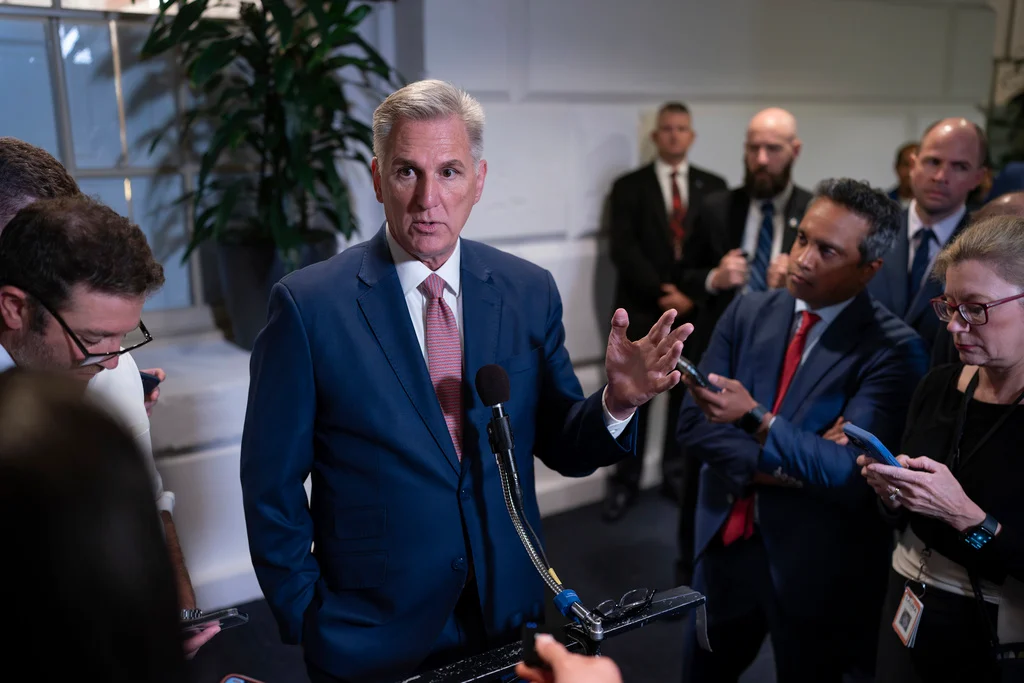
Speaker of the House Kevin McCarthy (R-Calif.) is a Republican. So it’s incumbent on him to make some fiscally responsible noises before falling into line and doing whatever the Democrats want.
Consider this gem:
“We have reached agreement in principle,” McCarthy said, “a deal worthy of the American people to lift people out of poverty with no new taxes or government overreach programs.”
He actually said that: “a deal worthy of the American people.”
“No new taxes.”
No new “government overreach programs,” whatever that means.
But we all know what it means.
By the way, is it the job of the government to “lift people out of poverty”?
We’ve come to the point where even Republicans say such things.
Forget all that talk about “limited government.”
We live now in the era of “government unlimited.”
This is the moment I haul in “Li’l Abner” and remind you about that prescient song, “The Country’s in the Very Best of Hands.”
“The Treasury says the national debt/ Is climbing to the sky/ And government expenditures/ Have never been so high/ It makes a fellow get a/ Gleam of pride within his eye,/ To see how our economy expands/ The country’s in the very best of hands.”
That used to be known as musical comedy.
Let me suggest that it represents an inversion of Karl Marx’s sly adaption of Georg Hegel’s dialectic.
Things repeat themselves, Hegel said.
Oh, yes, said Marx, but Hegel forgot to add, first as tragedy, then farce.
What we’re witnessing is the opposite.
It seemed almost funny at first, that farce.
Fodder for things such as “Li’l Abner.”
Then, we see the grimace behind the clown’s smile.
Turns out that behind the laughter, there was tragedy.
“The money that they taxes us/ That’s known as revenue/ They compound up collaterals/ Subtracts the residue/ Don’t worry about the principal/ And interest it incrues/ They’re shipping all that stuff to foreign lands/ The country’s in the very best of hands.”
Perhaps, as Aristotle observed in the “Nicomachean Ethics,” it’s a case of not being able to do the right thing because the choices we’ve made in the past have put the right course of action out of reach.
Some of the pols we continue to elect to govern us come close to admitting some such thing, although instead of invoking Aristotle, they say, “Our hands are tied,” “Previous obligations,” or “It’s the lesser of two evils.”
Who tied their hands? Who made those promises? Who steered the ship of state into these perilous waters?
Those are questions they don’t want asked.
And they won’t be asked. The country’s in the very best of hands.
-
The Countdown to Iran’s Liberation Has Begun
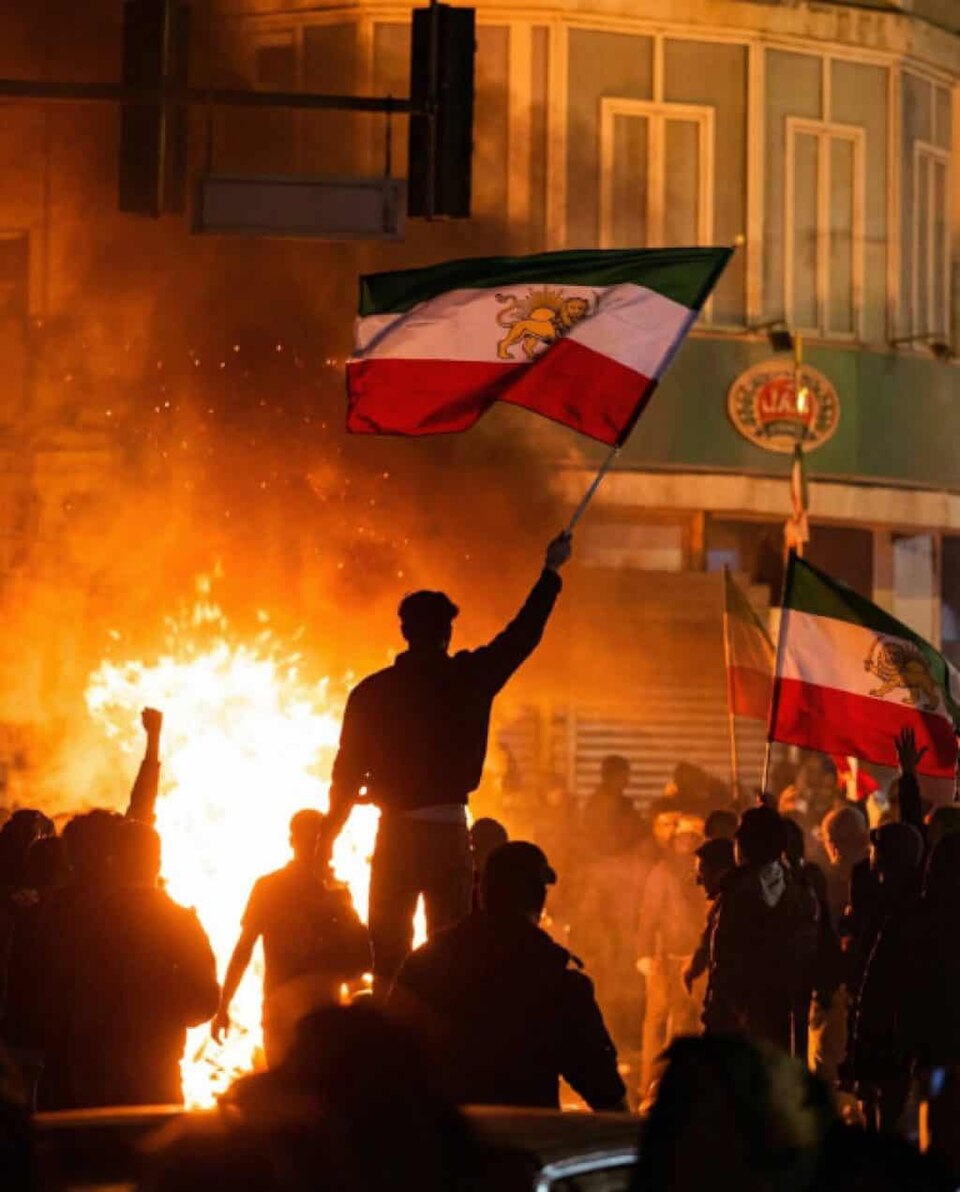
Peace talk aside, the ticking in Iran isn’t diplomacy—it’s a death-rattle, as a murderous regime nears judgment and a brutalized people pray that liberation, at last, is real.
-
The Course of the American Empire
In the 1830s, the English-born American artist Thomas Cole painted an ambitious sequence of five large rectangular canvases delineating “The Course of Empire.” He began with “The Savage State,” which depicts the rude life of humans before the advent of letters, domestication and permanent architecture. “The Arcadian or Pastoral State” is marked by harmony and some early accoutrements of civilization. “The Consummation of Empire,” at fifty-one inches by seventy-six inches, is a third larger than its fellows. Here we see a sun-drenched landscape transformed by a panoply of classical architecture counterpointed by bustling commerce and a triumphal, if overripe, stateliness. Next comes “Destruction.” The skies are dark now, the people besieged by ravening hordes, the monuments broken and burning. A distant full moon presides over “Desolation,” the last canvas. The scene is populated by shaggy, shattered remnants of human ingenuity, vast blighted columns and porticos half overgrown by vegetation, not a human soul in sight. Ozymandias would be at home.
I have thought often about Cole’s painted morality tale these past months. Where do you suppose we are on the itinerary he traced? I’d say somewhere between “Consummation” and “Destruction.” Is the process inevitable, as Cole seems to have believed? There are heartening signs to suggest not.
Unfortunately, few of those signs are patent in the United States at the moment.
But just look at Argentina. As I write, Javier Milei, the new “anarcho-capitalist” president of Argentina, has embarked in earnest on a regimen of “shock therapy” for his troubled country. You think we have runaway inflation in the US? Well, we do. But it will soon be nearly 200 percent in Argentina. Milei had barely taken office in December before he cut the government payroll by 5,000 jobs. He has abolished whole departments. He introduced a law legalizing the use of force for self-defense and decreed that welfare benefits would be stripped from anyone blocking traffic while protesting in the streets. He also banned the use of the word “free” to describe government largesse since the services are not “free.” On the contrary, they are paid for by the taxpayer. One commentator described this as “the most sensible law in world history.” Were it implemented in America, he noted, “the Democrat Party would literally not be able to campaign anymore.” Don’t hold your breath, though. Magical thinking obviates a multitude of unpalatable realities.
Lamenting “the hard decisions that will need to be made in coming weeks,” Milei told his supporters that “the goal is [to] start on the road to rebuilding our country, return freedom and autonomy to individuals and start to transform the enormous amount of regulations that have blocked, stalled and stopped economic growth.”
Instead of such frank acknowledgment and robust action, Joe Biden and his minders have retreated into Stalinist Newspeak. Everyone knows that civil society is frayed and tearing apart in America. Inflation and high interest rates are eating away at middle-class prosperity. The Southern border is a sort of Potemkin facsimile. Violent crime is out of control. The imperatives of woke ideology have undermined trust in our defining institutions from education and the media to churches and the military.
Joe Biden’s ostrich response is to insist that the media start reporting on the economy “the right way,” i.e., in a way that reflects well, if untruthfully, on the Biden administration. Pravda used to do the same thing. Most economists are predicting that the US economy will enter recession this year. But that unpleasant news is at odds with the happy pink unicorn tale that the Biden administration requires.
Meanwhile, Biden is also keen that Donald Trump be dealt with “the right way,” i.e., in a way that keeps him off the ballot. Otherwise, you see, people might vote for him, he might win, and therefore (therefore!) “Our Democracy™” might be undermined. The strategies are many. As I write, Trump faces more than ninety counts in lawfare cases in four separate persecutions, er, prosecutions. The latest wheeze is for various states to declare that he cannot be on the ballot because of “his role” in the January 6 “insurrection.” The rationale was put forward in the third section of the Fourteenth Amendment, an 1868 post-Civil War instrument which excluded anyone who had “engaged in insurrection or rebellion against [the US government].” The clause was designed to prevent Confederate rebels who had served in the US government from holding office. But that origin was no impediment to its being twisted into service to harass Donald Trump.
In December, the Colorado Supreme Court was the first entity to rule that Trump was ineligible to appear on the state ballot. That bizarre attack on democracy — not to be confused with “Our Democracy™” — instantly elicited some portion of the contempt and ridicule it deserved. As was pointed out at the time, all seven members of the court are Democrats. But the four members who voted to exclude him from the ballot were Ivy-educated. The rest went to state schools. A few days after the ruling was announced, the Colorado secretary of state intervened to put Trump back on the ballot while appeals are pending.
The herd mentality took hold as if it were a Covid emergency. Next up was Shenna Bellows, Maine secretary of state, who excluded Trump from the ballot because of “his role in the January 6 attack on the Capitol.” Two questions: was J6 an “insurrection?” Answer: no. What was Donald Trump’s “role” in the events of that day? To urge his followers to proceed peacefully and eschew violence.
That contravenes The Narrative, however. It is characteristic of the movement from the late stages of the Consummation of Empire to its destruction that truth be sacrificed to ideology. That’s where we are now. Which is why a columnist for Spiked denominated 2023 as “the year America became a banana republic.”
-
The Course of the American Empire
In the 1830s, the English-born American artist Thomas Cole painted an ambitious sequence of five large rectangular canvases delineating “The Course of Empire.” He began with “The Savage State,” which depicts the rude life of humans before the advent of letters, domestication and permanent architecture. “The Arcadian or Pastoral State” is marked by harmony and some early accoutrements of civilization. “The Consummation of Empire,” at fifty-one inches by seventy-six inches, is a third larger than its fellows. Here we see a sun-drenched landscape transformed by a panoply of classical architecture counterpointed by bustling commerce and a triumphal, if overripe, stateliness. Next comes “Destruction.” The skies are dark now, the people besieged by ravening hordes, the monuments broken and burning. A distant full moon presides over “Desolation,” the last canvas. The scene is populated by shaggy, shattered remnants of human ingenuity, vast blighted columns and porticos half overgrown by vegetation, not a human soul in sight. Ozymandias would be at home.
-
The Critical Temper
Encounter Books, 2021
On the occasion of its fortieth anniversary, The New Criterion has brought together a plump chrestomathy of essays demonstrating its range and acuity as America’s foremost review of culture and the arts. With contributions by Bruce Bawer, Anthony Daniels, Denis Donoghue, Joseph Epstein, John Steele Gordon, Victor Davis Hanson, Charles Hill, Donald Kagan, Roger Kimball, Heather Mac Donald, Myron Magnet, Andrew C. McCarthy, David Pryce-Jones, Andrew Roberts, Alexander McCall Smith, Aleksandr Solzhenitsyn, Keith Windschuttle, and many others, this collection of fifty essays brings you the best of the best: incisive cultural criticism, scintillating historical analysis, and robust commentary about the way we live now. Edited by Roger Kimball, this spiritual Baedeker is a timely repository of timeless writing about the figures, controversies, and challenges that define our life in the 2020s.
-
The Cunning of the Democrats’ Lawfare
It saddens me to admit it, but the evidence is too overwhelming to dismiss: Democrats are significantly more cunning than Republicans.
I say “Democrats,” but that is an imprecise, even a misleading, designation. Party affiliation is not now, if it ever was, a really accurate predictor of ideological coloration.
-
The Deep State vs Donald Trump Saga Is Not Over
As I have said before, I hope that the new Congress, which begins its session in just a couple of weeks, will continue the work of the January 6 Committee, minus Liz Cheney and the other kangaroos. The New York Times, in its best slant-the-news-while-appearing-magisterial modality, described the Committee’s 100-plus-page “Executive Summary” as a “report into the effort to overturn the 2020 election.” But surely the far greater attempt to impact the 2020 election was the FBI’s infiltration of Twitter and other social media platforms, Mark Zuckerberg’s half a billion dollars distributed like alms to NeverTrump sororities in battleground cities, etc., etc.