Today On The Eric Metaxas Show, Eric talks with Roger Kimball about New York City, Islam, and why they argue the West is losing civilizational confidence. They discuss whether the Islam vs Islamism distinction holds up, why assimilation and shared values matter for a free society, and what is happening in Europe and England right now. Then they pivot to Iran, regime change predictions, and why they believe Trump is reshaping the global order from the border to energy to foreign policy.
-
How Political Correctness Hijacked the Arts | Roger Kimball and Heather MacDonald

What gets to be called art — and who decides? In this wide-ranging Socrates Dialogues conversation, New York–based thinkers, writers, and art admirers Heather Mac Donald and Roger Kimball explore the definition of art and the history of the unmaking of beauty in modern contemporary art. Drawing on examples from Duchamp, Warhol, Serrano, Hirst, and others, the two discuss how the banal, the transgressive, and the political have reshaped the aesthetic experience of art, often robbing it of spiritual resonance.
-
Populism, X: The Imperative of Freedom
It is curious how certain words accumulate a nimbus of positive associations while others, semantically just as innocuous, wind up shouldering a portfolio of bad feelings.
Consider the different careers of the terms “democracy” and “populism.”
Do you know any responsible person who would admit to being opposed to democracy? No one who does not enjoy a large private income would risk it. But lots of people are willing to declare themselves anti-populist. The discrepancy is curious for several reasons.
It was not at all clear, Madison thought, that democracy was a reliable custodian of liberty.
For one thing, it is a testament to the almost Darwinian hardiness of the word “democracy.” In the fierce struggle among ideas for survival, “democracy” has not only survived but thrived. This is despite the fact that political thinkers from Plato and Aristotle through Cicero and down to modern times have been deeply suspicious of democracy. Aristotle thought democracy the worst form of government, all but inevitably leading to ochlocracy or mob rule, which is no rule.
In Federalist 10, James Madison famously warned that history had shown that democratic regimes have “in general been as short in their lives as they have been violent in their deaths.” “Theoretic politicians,” he wrote—and it would be hard to find a more contemptuous deployment of the word “theoretic”—such politicians may have advocated democracy, but that is only because of their dangerous and utopian ignorance of human nature. It was not at all clear, Madison thought, that democracy was a reliable custodian of liberty.
Nevertheless, nearly everyone wants to associate himself with the word “democracy.” Totalitarian regimes like to describe themselves as the “Democratic Republic” of wherever. Conservatives champion the advantages of “democratic capitalism.” Central planners of all stripes eagerly deploy programs advertised as enhancing or extending “democracy.” Even James Madison came down on the side of a subspecies of democracy, one filtered through the modulating influence of a large, diverse population and an elaborate scheme of representation that softened (Madison said “excluded”) the influence of “the people in their collective capacity.”
“Democracy,” in short, is a eulogistic word, what the practical philosopher Stephen Potter in another context apostrophized as an “OK word.” And it is worth noting, as Potter would have been quick to remind us, that the people pronouncing those eulogies delight in advertising themselves as, and are generally accepted as, “OK people.” Indeed, the class element and the element of moral approbation—of what some genius has summarized as “virtue signaling”—are key.
It is quite otherwise with “populism.” At first blush, this seems odd because the word “populism” occupies a semantic space closely adjacent to “democracy.” “Democracy” means “rule by the demos,” the people. “Populism,” according to The American Heritage Dictionary, describes “A political philosophy directed to the needs of the common people and advancing a more equitable distribution of wealth and power”— that is, just the sorts of things that the people, were they to rule, would seek.
But the fact is that “populism” is ambivalent at best. Sometimes, it is true, a charismatic figure can survive and even illuminate the label “populist” like a personal halo. Bernie Sanders managed this trick among the eco-conscious, racially omnivorous, non-gender-stereotyping, anti-capitalist beneficiaries of capitalism who made up his core constituency.
But it was always my impression that in this case the term “populist” was fielded less by Sanders or his followers than by his rivals and the media in an effort to fix him in the public’s mind as one of the many lamentable examples of not-Hillary, who herself was presumed to be popular though not populist.
There are at least two sides to the negative association under which the term “populist” struggles. On the one hand, there is the issue of demagoguery. Some commentators tell us that “populist” and “demagogue” are essentially synonyms (though they rarely point out that demagogos simply meant “a popular leader,” e.g., Pericles). The association of demagoguery and populism describes what we might call the command-and-control aspect of populism. The populist leader is said to forsake reason and moderation in order to stir the dark, chthonic passions of a semi-literate and spiritually unelevated populace.
On the other hand, there is the issue of the fertile but unedifying soil of that populace upon which the demagogic leader works. Anyone who has looked at the commentary on Brexit, the campaign and early months of the Trump administration, or the recent French election will have noted this.
Consider, to take but one example, how often the word “anger” and its cognates are deployed to evoke the psychological and moral failings of both the populist multitude and its putative leaders. In a remarkable, apocalyptic effusion published in the early hours of November 9, 2016, David Remnick, the editor of The New Yorker, warned that the Trump presidency represented “a rebellion against liberalism itself,” an “angry assault” on the civil rights of women, blacks, immigrants, homosexuals, and countless others. Later commentators warned about our “angry, cynical times,” the “raw, angry and aggrieved” tone of Trump’s rhetoric, the unchaperoned “anger” of Americans who felt they “had been left behind.” “Trump’s Anger Could Lead Down a Dangerous Road,” quoth cnn. “Inside Trump’s Anger and Impatience—and His Sudden Decision to Fire Comey,” The Washington Post. “How Festering Anger at Comey Ended in His Firing,” The New York Times.
There are occasional acknowledgments that the diagnosed “anger” may be understandable, even justified. But we are left with the unmistakeable impression that the phenomenon as a whole is something vicious and irrational. Anger “festers.” It leads to “sudden,” i.e., impulsive decisions. The road it steers us toward could be “dangerous.” (Ah, how cheap is possibility: when we read that “could be” dangerous, do we also think, as we should, that it might just as well not be?)
Populism seems incapable of escaping the association with demagoguery and moral darkness. Like the foul-smelling wounds of Philoctetes, the stench is apparently incurable. Granted, there are plenty of historical reasons for the association between demagoguery and populism, as such names as the brothers Tiberius and Gaius Gracchus, Father Coughlin, and Huey Long remind us.
Populism seems incapable of escaping the association with demagoguery and moral darkness.
Still, I suspect that in the present context the apparently unbreakable association between populism and demagoguery has less to do with any natural affinity than with cunning rhetorical weaponization. “Populism,” that is to say, is wielded less as a descriptive than as a delegitimizing term. Successfully charge someone with populist sympathies and you get, free and for nothing, both the imputation of demagoguery and what was famously derided as a “deplorable” and “irredeemable” cohort. The element of existential depreciation is almost palpable.
So is the element of condescension. Inseparable from the diagnosis of populism is the implication not just of incompetence but also of a crudity that is part aesthetic and part moral. Hence the curiously visceral distaste expressed by elite opinion for signs of populist sympathy. When Hillary Clinton charged that half of Donald Trump’s supporters were an “irredeemable” “basket of deplorables,” when Barack Obama castigated small-town Republican voters as “bitter” folk who “cling to guns or religion or antipathy to people who aren’t like them or anti-immigrant sentiment or anti-trade sentiment,” what they expressed was not disagreement but condescending revulsion.
Ithink I first became aware that the charge of populist sympathies could have a powerful political, moral, and class delegitimizing effect when I was in London last June to cover the Brexit vote. Nearly everyone I met, from Tory ministers to taxi drivers, from tourists to tradesmen, was a Remainer. The higher up the income and class scale you went, the more likely it was that your interlocutor would be in favor of Britain’s remaining in the European Union. And the more pointed would be his disparagement of those arguing in favor of Brexit. The Brexiteers were said to be “angry,” yes, but also ignorant, fearful, xenophobic, and racist.
Except that they weren’t, not the ones I met, anyway. For them, Brexit turned on a simple question: “Who rules?” Is the ultimate source of British sovereignty Parliament, as had been the case for centuries? Or is it Brussels, seat of the European Union?
The question of sovereignty, I believe, takes us to the heart of what in recent years has been touted and tarred as the populist project.
Consider Britain. Parliament answers to the British voters. The European Union answers to—well, to itself. Indeed, it is worth pausing to remind ourselves how profoundly undemocratic is the European Union. Its commissioners are appointed, not elected. They cannot be turned out of office by voters. If the public votes contrary to the wishes of the E.U.’s commissars in a referendum, they are simply presented with another referendum until they vote the “right” way. The E.U.’s financial books have never been subject to a public audit. The corruption is just too widespread. Yet the E.U.’s agents wield extraordinary power over the everyday lives of their charges. A commissioner in Brussels can tell a property owner in Wales what sort of potatoes he may plant on his farm, how he must calculate the weight of the products he sells, and whom he must allow into his country. He can outlaw “racism” and “xenophobia”—defined as harboring “an aversion” to people based on “race, colour, descent, religion or belief, national or ethnic origin” and specify a penalty of “at least” two years’ imprisonment for infractions. He can “lawfully suppress,” as the London Telegraph reported, “political criticism of its institutions and of leading figures,” thus rendering the commissars of the E.U. not only beyond the vote but also beyond criticism.
It’s a little different in the United States. I’ll come to that below. At the moment, it is worth noting to what extent the metabolism of this political dispensation was anticipated by Alexis de Tocqueville in his famous passages about “democratic despotism” in Democracy in America. Unlike despotism of yore, Tocqueville noted, this modern allotrope does not tyrannize over man—it infantilizes him. And it does this by promulgating ever more cumbersome rules and regulations that reach into the interstices of everyday life to hamper initiative, stymie independence, stifle originality, homogenize individuality. This power, said Tocqueville, “extends its arms over society as a whole.”
It does not break wills, but it softens them, bends them, and directs them; it rarely forces one to act, but it constantly opposes itself to one’s acting; it does not destroy, it prevents things from being born; it does not tyrannize, it hinders, compromises, enervates, extinguishes, dazes, and finally reduces each nation to being nothing more than a herd of timid and industrious animals of which the government is the shepherd.
Tocqueville’s analysis has led many observers to conclude that the villain in this drama is the state. But the political philosopher James Burnham, writing in the early 1940s in The Managerial Revolution, saw that the real villain was not the state as such but the bureaucracy that maintained and managed it. It is easy to mock the apparatchiks who populate the machinery of government. Thus James H. Boren writes wickedly that “the noblest of all of man’s struggles are those in which dedicated bureaucrats, armed with the spirit of dynamic inaction, have fought to protect the ramparts of creative nonresponsiveness from the onslaughts of mere citizens who have demanded action in their behalf.” But the comic potential of the morass should not blind us to the minatory nature of the phenomenon. Indeed, it presents a specimen case of the general truth that the preposterous and the malevolent often co-mingle. The shepherd of which Tocqueville wrote was really a flock of shepherds, a coterie of managers who, in the guise of doing the state’s business, prosecuted their own advantage and gradually became a self-perpetuating elite that arrogated to itself power over the levers of society.
Anatomizing this sleight-of-hand is at the center of “James Burnham’s Managerial Elite,” Julius Krein’s essay in the inaugural issue of American Affairs. “Although the managerial elite uses the state as an instrument to acquire power,” Krein notes, “the real enemy is not the state but rather the managerial separation of political and economic power from the liberal social contract.”
This separation of the real power of society from the economy and political life renders the managerial elite all but untouchable. And this, as Burnham saw, was the property neither of liberalism nor of conservatism but rather of anterior forces that engulfed both. “The contradiction of contemporary conservatism,” Krein writes,
is that it is an attempt to restore the culture and politics of bourgeois capitalism while accelerating the economy of managerialism. Because of its failure to recognize this contradiction, “much of conservative doctrine is, if not quite bankrupt, more and more obviously obsolescent,” as Burnham wrote in 1972. Since then it has only evolved from obsolescent to counterproductive. At this point, expanding “free markets” no longer has anything to do with classical American capitalism. It is simply the further emancipation of the managerial elite from any obligations to the political community. Likewise, promoting democracy as an abstract, universalist principle only undermines the sovereignty of the American people by rejecting national interests as a legitimate ground of foreign policy.
Sovereignty, Burnham saw, was shifting from Parliaments to what he called “administrative bureaus,” which increasingly are the seats of real power and, as such, “proclaim the rules, make the laws, issue the decrees.” As far back as the early 1940s, Burnham could write that “ ‘Laws’ today in the United States . . . are not being made any longer by Congress, but by the nlrb, sec, icc, aaa, tva, ftc, fcc, the Office of Production Management (what a revealing title!), and the other leading ‘executive agencies.’ ” And note that Burnham wrote decades before the advent of the epa, hud, cfpb, fsoc, the Department of Education, and the rest of the administrative alphabet soup that governs us in the United States today.
Iam convinced that the issue of sovereignty, of what we might call the location of sovereignty, has played a large role in the rise of the phenomenon we describe as “populism” in the United States as well as Europe. For one thing, the question of sovereignty, of who governs, stands behind the rebellion against the political correctness and moral meddlesomeness that are such conspicuous and disfiguring features of our increasingly bureaucratic society. The smothering, Tocquevillian blanket of regulatory excess has had a wide range of practical and economic effects, stifling entrepreneurship and making any sort of productive innovation difficult.
A reassertion of independence.
But perhaps its deepest effects are spiritual or psychological. The many assaults against free speech on college campuses, the demand for “safe spaces” and “trigger warnings” against verbal or fashion-inspired “micro-aggressions” (Mexican hats, “offensive” Halloween costumes, etc.) are part of this dictatorship of political correctness. In The Road to Serfdom, Friedrich Hayek said that one of the “main points” of his argument concerned “the psychological change,” the “alteration of the character of the people,” that extensive government control brought in its wake. The alteration involves a process of softening, enervation, infantilization even: an exchange of the challenges of liberty and self-reliance—the challenges, that is to say, of adulthood—for the coddling pleasures of dependence. Max Weber spoke in this context of “Ordnungsmenschen,” men who had become increasingly dependent on an order imposed upon them from above. Breaking with that drift becomes more and more difficult the more habituated to dependence a people becomes. In this sense, what has been described as a populist upsurge against political correctness is simply a reassertion of independence, a reclamation of what turns out to be a most uncommon virtue, common sense.
The issue of sovereignty also stands behind the debate over immigration: indeed, is any issue more central to the question Who governs? than who gets to decide a nation’s borders and how a country defines its first person plural: the “We” that makes us who we are as a people?
Throughout his campaign, Donald Trump promised to enforce America’s immigration laws, to end so-called “sanctuary cities,” which advertise themselves as safe havens for illegal aliens (though of course they do not call them “illegal aliens”), and to sharpen vetting procedures for people wishing to immigrate to America from countries known as sponsors of terrorism.
The President sometimes overstated and not infrequently misstated his case. Semantic precision is not a Trumpian speciality. But political effectiveness may be. Behind the Sturm und Drang that greeted Trump’s rhetoric on immigration, we can glimpse two very different concepts of the nation state and world order. One view sees the world as a collection of independent sovereign countries that, although interacting with one another, regard the care, safety, and prosperity of their own citizens as their first obligation. This is the traditional view of the nation state. It is also Donald Trump’s view. It is what licenses his talk of putting “America First,” a concept that, pace the anti-Trump media, has nothing to do with Charles Lindbergh’s isolationist movement of the late 1930s and everything to do with fostering a healthy sense of national identity and purpose.
The alternative view regards the nation state with suspicion as an atavistic form of political and social organization. The nation state might still be a practical necessity, but, the argument goes, it is a regrettable necessity inasmuch as it retards mankind’s emancipation from the parochial bonds of place and local allegiance. Ideally, according to this view, we are citizens of the world, not particular countries, and our fundamental obligation is to all mankind.
This is the progressive view. It has many progenitors and antecedents. But none is more influential than “Perpetual Peace: A Philosophical Sketch,” a brief essay that Immanuel Kant published in 1795 when he was seventy-one. The burden of the essay is to ask how perpetual peace might be obtained among states. The natural condition of mankind, Kant acknowledges, is war. But with the advent of “enlightened concepts of statecraft,” mankind, he suggests, may be able to transcend that unfortunate habit of making war and live in perpetual (ewigen) comity.
Kant lists various conditions for the initial establishment of peace—the eventual abolition of standing armies, for example—and a few conditions for its perpetuation: the extension of “universal hospitality” by nations was something that caught my eye. Ditto “world citizenship.” “The idea of . . . world citizenship,” he says at the end of the essay, “is no high-flown or exaggerated notion. It is a supplement to the unwritten code of the civil and international law, indispensable for the maintenance of the public human rights and hence also of perpetual peace.”
It is one thing to declare war illegal; it is quite another to enforce that edict.
Kant makes many observations along the way that will be balm to progressive hearts. He is against “the accumulation of treasure,” for example, because wealth is “a hindrance to perpetual peace.” By the same token, he believes that forbidding the system of international credit that the British empire employed “must be a preliminary article of perpetual peace.” Credit can be deployed to increase wealth, ergo it is suspect. Kant says that all states must be “republican” in organization. By that he means not that they must be democracies but only that the executive and legislative functions of the state be distinguished. (Indeed, he says that democracy, “properly speaking,” is “necessarily a despotism” because in it the executive and legislative functions of governments are both vested in one entity, “the people.”) He looks forward to the establishment of a “league of nations” (Völkerbund), all of which would freely embrace a republican form of government.
It would be hard to overstate the influence of Kant’s essay. It stands behind such progressive exfoliations as Woodrow Wilson’s “Fourteen Points,” not least the final point that looked forward to the establishment of a League of Nations. You can feel its pulse beating in the singing phrases of the 1928 Kellogg-Briand Pact, which outlawed war. It is worth noting that among the initial fifteen signatories of that noble-sounding pact, along with the United States, France, and England, were Germany, Italy, and Japan. What does that tell us about the folly of trusting paper proclamations not backed up by the authority of physical force? It is one thing to declare war illegal; it is quite another to enforce that edict.
Kant’s essay also directly inspired the architects of the United Nations and, in our own day, the architects of the European Union and the battalions of transnational progressives who jettison democracy for the sake of a more-or-less nebulous (but not therefore un-coercive) ideal of world citizenship.
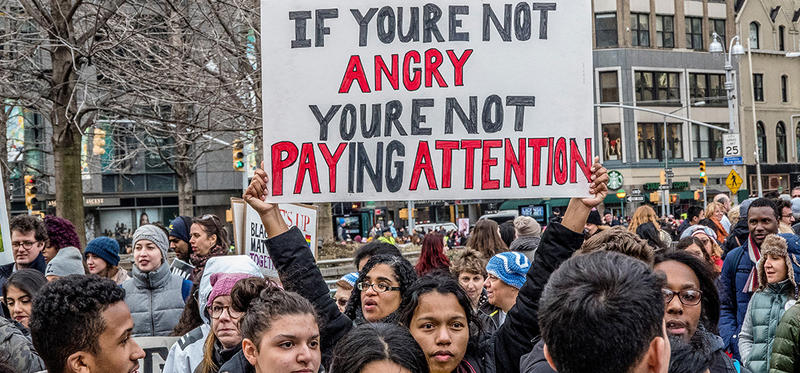
I would not care to wager on how many of the hysterics who congregated at airports across the country to protest Donald Trump’s effort to make the citizens of this country safer were students of Kant. Doubtless very few. But all were his unwitting heirs. “Universal hospitality”: how the protestors would have liked that! (Though to be fair to Kant, he did note that such hospitality “is not the right to be a permanent visitor.”) I have no doubt that the motivation of the protestors had many sources. But to the extent that it was based on a political ideal (and not just partisan posturing or a grubby bid for notoriety and power), the spirit of Kant was hovering there in the background.
Kant was not without a sense of humor. He begins his essay by noting that he took his title from a sign outside a Dutch pub. “Pax Perpetua” read the sign, and below the lettering was the image of a graveyard. Perhaps the universal perpetuity of death is the only peace that mankind may really look forward to. Kant clearly wouldn’t agree, but it was charming of him to acknowledge that the idea of a genuine perpetual peace for mankind might be regarded by many as nothing more than a “sweet dream” of philosophers.
What has been called the populist spirit aims to rouse us from that “sweet dream”—what James Madison might have called the “theoretic” reverie of the meddling class whose designs for our salvation always seem to involve the extension of their own power and prerogative. In this sense, the issue of sovereignty also stands behind the debates over the relative advantages and moral weather of “globalism” vs. “nationalism”—a pair of terms almost as fraught as “democracy” and “populism”—as well as the correlative economic issues of underemployment and wage stagnation. “Theoretic” politicians may advocate “globalism” as a necessary condition for free trade. But the spirit of local control tempers the cosmopolitan project of a borderless world with a recognition that the nation state has been the best guarantor not only of sovereignty but also of broadly shared prosperity. What we might call the ideology of free trade—the globalist aspiration to transcend the impediments of national identity and control—is an abstraction that principally benefits its architects. As R. R. Reno, the editor of First Things, pointed out in a recent Op-Ed for The New York Times, “Globalism poses a threat to the future of democracy because it disenfranchises the vast majority and empowers a technocratic elite.”
In the end, what James Burnham described as the “managerial revolution” is part of a larger progressive project. The aim of this project is partly to emancipate mankind from such traditional sources of self-definition as national identity, religious affiliation, and specific cultural rootedness, partly to perpetuate and aggrandize the apparatus that oversees the resulting dissolution. Burnham castigates this hypertrophied form of liberalism (what we might call “illiberal liberalism”) as “an ideology of suicide” that has insinuated itself into the center of Western culture. He acknowledges that the proposition may sound hyperbolic. “Suicide,” he notes, may seem “too emotive a term, too negative and ‘bad.’ ” But it is part of the pathology that Burnham describes that such objections are “most often made most hotly by Westerners who hate their own civilization, readily excuse or even praise blows struck against it, and themselves lend a willing hand, frequently enough, to pulling it down.” The issue, Burnham saw, is that modern liberalism has equipped us with an ethic too abstract and empty to inspire real commitment. Modern liberalism, he writes,
does not offer ordinary men compelling motives for personal suffering, sacrifice, and death. There is no tragic dimension in its picture of the good life. Men become willing to endure, sacrifice, and die for God, for family, king, honor, country, from a sense of absolute duty or an exalted vision of the meaning of history. . . . And it is precisely these ideas and institutions that liberalism has criticized, attacked, and in part overthrown as superstitious, archaic, reactionary, and irrational. In their place liberalism proposes a set of pale and bloodless abstractions—pale and bloodless for the very reason that they have no roots in the past, in deep feeling and in suffering. Except for mercenaries, saints, and neurotics, no one is willing to sacrifice and die for progressive education, medicare, humanity in the abstract, the United Nations, and a ten percent rise in Social Security payments.
In his view, the primary function of liberalism was to “permit Western civilization to be reconciled to dissolution,” to view weakness, failure, even collapse not as a defeat but “as the transition to a new and higher order in which Mankind as a whole joins in a universal civilization that has risen above the parochial distinctions, divisions, and discriminations of the past.”
What has been called “populism” is a visceral reaction against these forces of dissolution.
Around the time that Donald Trump took office, his chief strategist Steve Bannon said that his goal was to “deconstruct the administrative state.” The phrase “administrative state”—also called “the regulatory state” or “the deep state”—has lately floated into common parlance. In The Administrative Threat, the legal scholar Philip Hamburger describes it as “a state within a state,” a sort of parallel legal and political structure populated by unelected bureaucrats. This amorphous congeries of agencies and regulations has become, Hamburger argues, “the dominant reality of American governance,” intruding everywhere into economic and social life.
What has been called “populism” is a visceral reaction against forces of dissolution.
Article I of the Constitution vests all legislative power in Congress, just as Article III vests all judicial authority in the Court. The administrative state is a mechanism for circumventing both. As such, Hamburger argues, the administrative state operates outside the Constitution.
When the Constitution places all legislative powers in Congress, it gives Congress not only the power to make law but also the power to unmake it. And it thereby bars the executive from suspending or dispensing with the law. When the Constitution, moreover, places the judicial power in the courts and guarantees the due process of law, it precludes the executive from telling the courts not to apply the law, and prevents the courts from abandoning their own judgment about what the law requires.
Binding citizens not through Congressionally enacted statutes but through the edicts of the managerial bureaucracy, the administrative state is “all about the evasion of governance through law, including an evasion of constitutional processes and procedural rights.” Accordingly, Hamburger concludes, the encroaching activity of the administrative state represents “the nation’s preeminent threat to civil liberties.”
Hamburger draws an analogy between the behavior of the administrative state and the behavior of such despotic monarchs as James I, Charles I, and James II. Instead of persuading Parliament to repeal or revise a statute, the British king simply evaded its force by decreeing that some or all of his subjects were not subject to its strictures. His power was absolute not merely in the sense that it was all but unlimited but also in the sense that it was independent or outside of the law. Students of Latin will recall the Ablative Absolute, a construction in which an ablative phrase is absolutum, “loosened” from or independent of the main clause of a sentence. Hamburger shows how the growth of the administrative state represents an extralegal “revival of absolute power” in this sense, one that threatens to transform Constitutional rights and guarantees into mere “options” that the government bestows or withholds at its pleasure. “The evasion,” he notes, “thereby changes the very nature of procedural rights. Such rights traditionally were assurances against the government. Now they are but one of the choices for government in its exercise of power. Though the government must respect these rights when it proceeds against Americans in court, it has the freedom to escape them by taking an administrative path.”
Just as British kings in the seventeenth century evaded Parliament through such expedients as the Star Chamber and the exercise of royal prerogatives and royal waivers—what John Adams castigated as “those badges of domination called prerogatives”—so the administrative state today operates in violation of the Constitution and beyond the authority of Congress. Barack Obama decreed that certain politically unpalatable provisions of the Affordable Care Act not be enforced, and presto, they were not enforced, even though they were the law of the land. He instructed his Department of Justice to intervene to prevent Arizona and other states from enforcing certain aspects of immigration law. He even forced public institutions to accommodate self-declared “transgender” persons in the toilets of their choice; he connived with lawsuits punishing bakers and Catholic hospitals and hobby shops who chose not to join this week’s politically correct campaign for the sexually exotic. The Constitution may have vested all legislative power in Congress and entrusted all judicial power to the courts, but the administrative state sidesteps those requirements by erecting a parallel bureaucratic structure of enforcement and control.
The administrative state today operates in violation of the Constitution.
“Eighteenth-century Americans,” Hamburger notes, “assumed that a rule could have the obligation of law only if it came from the constitutionally established legislature elected by the people.” Today, Americans find their lives directed by a jumble of agencies far removed from the legislature and staffed by bureaucrats who make and enforce a vast network of rules that govern nearly every aspect of our lives.
One of the most disturbing aspects of Hamburger’s analysis is the historical connection he exposes between the expansion of the franchise in the early twentieth century and the growth of administrative, that is to say, extra-legal, power. For the people in charge, equality of voting rights was one thing. They could live with that. But the tendency of newly enfranchised groups—the “bitter clingers” and “deplorables” of yore—to reject progressive initiatives was something else again. As Woodrow Wilson noted sadly, “The bulk of mankind is rigidly unphilosophical, and nowadays the bulk of mankind votes.” What to do?
The solution was to shift real power out of elected bodies and into the hands of the right sort of people, enlightened people, progressive people, people, that is to say, like Woodrow Wilson. Thus Wilson welcomed the advent of administrative power as a counterweight to encroaching democratization. And thus it was, as Hamburger points out, that we have seen a transfer of legislative power to the “knowledge class,” the managerial elite that James Burnham anatomized.
A closer look at the so-called “knowledge class” shows that what it knows best is how to preserve and extend its own privileges. Its activities are swaddled in do-gooder rhetoric about serving the public, looking after “the environment,” helping the disadvantaged, etc., but what they chiefly excel at is consolidating their own power.
In Thoughts on the Cause of the Present Discontents (1770), Edmund Burke criticized the Court of George III for circumventing Parliament and establishing by stealth what amounted to a new regime of royal prerogative and influence-peddling. It was not as patent as the swaggering courts of James I or Charles I. George and his courtiers maintained the appearance of parliamentary supremacy. But a closer look showed that the system was corrupt. “It was soon discovered,” Burke wrote with sly understatement, “that the forms of a free, and the ends of an arbitrary Government, were things not altogether incompatible.” That discovery stands behind the growth of the administrative state. Under the cloak of democratic institutions, its essentially undemocratic activities pursue an expansionist agenda that threatens liberty in the most comprehensive way, by circumventing the law.
At the same time, however, a growing recognition of the totalitarian goals of the administrative state has fed what many have called a populist uprising here and in Europe. “Populist” is one word for the phenomenon. An affirmation of sovereignty, underwritten by a passion for freedom, is another, possibly more accurate, phrase.
-
Why Poetry Matters
Among the serious people who actually run the world, poetry does not rank high on their roster of concerns.
That is a pity.
In a world that is (as T.S. Eliot said in the first of his “Four Quartets”) “distracted from distraction by distraction,” poetry can offer new acuities and welcoming restorative silences.
That might seem like small beer in a fraught world teetering on catastrophes real and imagined.
But it is worth remembering the central place that poetry once occupied in the patrimony of human culture.
I was going to say that the question of whether poetry continues to occupy an important position in the metabolism of culture is an open question.
But in fact, we all know that the question has been answered, and the answer is no.
To be sure, every teacher, and probably most parents, “approve” of poetry (if not necessarily of poets).
Poetry is one of those certified “good things” of which one is naturally in favor.
But approval does not entail acquaintance, let alone mastery.
Nor does it entail the vitality of the thing approved.
An interesting history might be written of those human activities that, from the point of view of established taste, have made the journey from urgent requirement through commendable accomplishment to respectable curiosity.
It pains me to acknowledge that for most of us, poetry occupies a place in that melancholy narrative.
I hasten to add, however, that the same might be said for much traditional cultural endeavor.
We live at a moment when many of the institutions traditionally entrusted to safeguard and transmit that power have passed on to other, more demotic entertainments.
One marker of that passage is velocity.
Woody Allen once quipped that he took a speed-reading course and was able to get through “War and Peace” in 10 minutes. “It’s about Russia,” he deadpanned.
One of poetry’s great gifts is to offer us lessons in slow reading.
By resisting the intelligence “almost successfully,” as Wallace Stevens put it, poetry trips us up, slows us down, and makes us pause to consider, deliberate, and savor.
The resistance is as important as the ultimate success.
Sometimes, indeed, it is the success.
The cognitive friction that poetry involves is especially valuable at a time when speed is king.
The risible idea of reading “War and Peace” in 10 minutes underscores the philistinism of confusing reading with the acquisition of information.
In “New Grub Street” (1891), George Gissing satirizes the journalistic mores of his time.
Toward the end of the novel, a few characters are discussing a new publication designed to appeal to “the quarter educated; … the young men and women who can just read, but are incapable of sustained attention.”
Its working title is “Chat,” but that is too weighty.
In order to succeed, it needs to be rebaptized.
“Chat doesn’t attract anyone, but Chit-Chat would sell like hot cakes.”
The contents would be true to the title: “No article in the paper is to measure more than two inches in length, and every inch must be broken into at least two paragraphs.”
It may be worth noting that poetry, like all human activities, is susceptible to perversion.
There are contemporary “schools” or movements of poetry that endeavor to exploit, rather than resist, the aimless detritus of our digital cacophony, glorying in new variations of the aleatory.
But there is also “music” indistinguishable from tribal grunting.
Back in 2011, The New York Times, that reliable chameleon on the motley of the moment, breathlessly reported that “there’s evidence that the literary flowering of Twitter may actually be taking place. The Twitter haiku movement—‘twaiku’ to its initiates—is well under way.”
I don’t doubt it.
But while such phenomena may provide employment for sociologists, anthropologists, and specialists in mental and psychological incapacity, they have little to tell us, except by way of contrast, about poetry in any vital sense.
If poetry is the enemy of speed-reading, it is an ally of Mnemosyne, the goddess of memory.
W.H. Auden once defined poetry as “memorable speech.”
We cannot, for example, encounter Auden’s poem “September 1, 1939,” without ever after remembering the poet in that dive on “Fifty-second Street/ Uncertain and afraid/ As the clever hopes expire/ Of a low dishonest decade.”
In our increasingly disposable culture, poetry waves the flag of permanence.
It musters memory against the onslaughts of ephemera.
Robert Frost may have overstated the case when, in 1915, he advised his friend Louis Untermeyer to “Take care of the sound and the sense will take care of itself.”
But to say that a case is overstated is not to deny that there is a case that’s been made.
“Poetry,” wrote Eliot, “communicates before it is understood.”
What it communicates is the pressure of emotional, not propositional, truth.
Poetry conjures with the music of the matter, not the matter of fact.
It is part of the sly candor of language that when we have memorized something, we say we have it “by heart.”
The pressure that sound and rhythm exert upon memory is more material than mental, more a matter of felt presence than calculated result.
It is what Wallace Stevens called “the motive for metaphor,” “shrinking from/ The weight of primary noon,” the definite, discursive “A B C of being,” in favor of half seasons, of fall, of spring and “the half colors of quarter things,/ Of things that would never be quite expressed,/ Where you yourself were never quite yourself/ And did not want nor have to be …”
In “Poetic Meter and Poetic Form,” the critic Paul Fussell adduces William Blake’s poem “The Sick Rose” to underscore what we might call the semantics of sound, the reason behind the rhythm. “The whole poem,” Fussell writes, “depends upon one crucial substitution.”
O Rose thou art sick,The invisible worm,That flies in the nightIn the howling storm:
Has found out thy bedOf crimson joy:And his dark secret loveDoes thy life destroy. “All goes swimmingly,” Fussell observes, “until line 7.”
The iambic-anapestic rhythm trips along pretty regularly.
Then this happens: “And his/dārk sēc/ret love/.”
That spondee—it’s the only one in the poem—is the rhythmic and semantic consummation of the poem.
“The meter conducts the argument,” Fussell writes. “The meter is the poem.”
The imagined botanical tragedy achieves a sharp and sudden humanity because of Blake’s cunning metrical deployment.
“It’s about Russia.”
Poetry is an ally of civilization because it brings that speeding vehicle to a skidding stop.
What’s the payoff, the cash value, the “real-world” take away?
Only accumulated protestations of the human heart.
Only that. Contemplating our civilization’s “gigantic technological structure, a skyscraper almost high enough to reach the moon,” the critic Northrop Frye observed that poetry “never speaks unless we take the time to listen in leisure, and it speaks only in a voice too quiet for panic to hear. And then all it has to tell us, when we look over the edge of our leaning tower, is that we are not getting any nearer heaven, and that it is time to return to earth.”
-
Why Shouldn’t the Board of Peace Replace the UN?
It’s not hard to be more effective than the UN, but one has to start somewhere.
-
Why Socialism Will Fail
The philosopher David Hume warned us not to mistake “constant conjunction” for causation. It’s good advice, though it is not the sort of universal disturbance in the force that some philosophers, eager to jettison old certitudes, believe it to be.
-
Why the Diversity Industry Is So Homogenous
It’s one of the great ironies of our time that the word “diversity” is repeated everywhere, while the opposite, a stultifying homogeneity, is the reality that’s enforced “on the ground.”
Our educational institutions offer the classic example.
Is there any self-respecting college or university that doesn’t tout its commitment to “diversity” these days?
You can’t peruse a college’s promotional literature, let alone set foot on its campus, without being inundated by assurances that diversity is its most cherished value, the cynosure to which every other pursuit is subordinated.
But when you look at what they actually teach and preach, it turns out that rigid conformity is the order of the day.
We used to titter that there were people whose title was some variation on “dean of diversity.”
“You’re kidding, right?” was the response.
No one is laughing now.
On an increasingly wide range of subjects, only one opinion is granted the patent of diversity. Those deans are there not to invigilate academic excellence but to enforce social and moral conformity.
From an epistemic linguistic perspective, what we’re seeing is the triumph of deflationary or ironizing quotation marks.
Everyone can appreciate the difference between “fresh fish” and “‘fresh’ fish.”
If you’re looking for dinner, avoid the latter.
Just so, if you hear an academic or an academic administrator (or, for that matter, a government bureaucrat) proclaim his commitment to diversity, you can be sure that he means his commitment to “diversity,” that is, conformity masquerading as diversity.
We all know this. It’s part of what Anthony Trollope called “the way we live now.”
I said that this fact was one of the great ironies of our age.
Some might object that it’s really just one of the great hypocrisies of the age.
There’s something to that.
There’s certainly plenty of hypocrisy abroad.
But I remember Francois de La Rochefoucauld’s observation that hypocrisy was the tribute that vice paid to virtue. What he meant was that hypocrisy, although regrettable, at least recognized the claims of the virtue it pretended to embody.
The seamless intolerance that fuels our culture of pseudo-diversity has no room for such recognitions or extenuations.
Conformity and uniformity are the goals, even if they must be packaged in an emollient rhetoric of diversity.
By now, I believe, this phenomenon is widely recognized.
Just a few years ago, when someone described some individuals or behavior as “woke,” people blinked and smiled.
Was woke the same as “enlightened”?
Not hardly.
Like many spiritual toxins, wokeness started life as a lark.
That is, people couldn’t take it seriously, so they laughed at it.
It was ridiculous, so they neglected its claws.
The same thing happened with political correctness, which began life in the satire pages of a student publication at Brown University.
My own sense is that the laughter was misplaced.
It’s not that the whole spectrum of woke self-indulgence wasn’t ridiculous.
It’s just that the ridiculous often cohabits seamlessly with the malevolent, a fact we don’t see or are prepared to excuse because of the silliness.
This often happened in response to the antics of “the ‘60s.”
“Oh, those kids, with their rebarbative music, outré clothes, naïve political ‘idealism’!”
It was easy to dismiss it all as a typical product of self-indulgence and affluence.
That might have been part of the story.
But that sudden change in manners and morals was also fired by something deeper, darker, and less smiling.
The drug culture and sexual license were the tips of that iceberg.
And behind that was the gloomy, unsmiling progress of what the Italian Marxist Antonio Gramsci called “the long march through the institutions.”
The institutions in question ran the gamut from the family and the churches through schools, colleges, the media, and, finally, corporate and governmental bureaucracies.
That “long march” began on the fringes of culture in the late 1950s before moving to the center in the ‘60s and ’70s.
It proceeded like Johnny Appleseed, dropping fertile if poisonous seeds that took years to germinate and sprout.
Now, they have fully blossomed, as phrases such as “drag queen story hour,” “transsexual bathrooms,” and “white supremacy” remind us.
If someone succumbed to a Rip Van Winkle slumber in 1963, do you suppose he would recognize his culture upon awakening 70 years later, in 2023?
I doubt it.
No one has really explained how this co-optation of our culture came about.
Doubtless, there are many contributory causes.
One of the most original efforts to explain the monolithic nature of the beast was just published by the commentator Glenn Reynolds at his Substack under the title “Thoughts on our Ruling-Class Monoculture.”
Reynolds offered a long and complex argument.
Here, I’ll just note two things.
First, he took off from Elon Musk’s recent observation that the ideology of wokeness amounted to a kind of debilitating “mind virus.”
Musk’s tweet underscored the gravity of the phenomenon.
The triumph of wokeness would spell the eclipse of individual liberty and public access to the past.
Orwell warned that we’ll know that Big Brother and Newspeak finally prevailed when “every record has been destroyed or falsified, every book rewritten, every picture has been repainted, every statue and street building has been renamed, every date has been altered.”
We’re well on our way there as, just a day or two back, the revelations about the rewriting of Roald Dahl’s children’s books remind us.
The second takeaway from Reynolds’s essay revolves around his suggestion that the homogeneity of woke ideology is a byproduct of the uniformity of the elites that preside over our culture.
There are nine Supreme Court justices.
Until the confirmation of Amy Coney Barrett, who went to Notre Dame Law School, all were products of Harvard or Yale.
That graphic expression of the monoculture of our elites can be traced throughout the administrative bureaucracy that increasingly controls our lives.
Reynolds noted that real diversity is an effective biological stratagem against dangerous viruses.
His speculations about this are provocative and well worth reading.
Here I’ll just note the possible silver lining to his discussion.
The elite monoculture currently abets the stultifying ethos of woke culture.
It can seem irrefragable and unappeasable.
But its very monolithic nature and totalitarian ambition make it secretly vulnerable.
Successfully attack one element of the monoculture and the whole domino-like structure is liable to fall.
If we had a more diverse ruling class, Reynolds noted, “ideas would not spread so swiftly or be received so uncritically.”
“People with different worldviews would respond differently to ideas as they entered the world of discourse,” he said. “There would be criticism and there would be debate.” A consummation devoutly to be wished, especially as the alternative is likely to be a totalitarian nightmare.
-
Why the Establishment Hates Donald Trump
Like many commentators who have struggled to understand the reasons for the inveterate hatred of Donald Trump among the swank people who actually run the country, I have generally come up with two answers.
-
Why the Left Wants the Right to ‘Lower the Temperature’
Charlie Kirk’s assassination exposed the left’s projection, their calls to “lower the temperature,” and sparked a massive surge in Turning Point’s growth and influence.
-
Why Trump’s Rally Mattered More than the GOP Debate in Miami
Do you believe in coincidences? I used to. But like Macbeth I have just “supped full with horror.” That is, I have been flipping back and forth between the glitzy but pointless Republican debate in Miami and Donald Trump’s rally in nearby Hialeah, Florida.
-
Why We’ll All Miss Boris
I think that Thomas Babington Macaulay had the last word about Boris Johnson’s forced resignation as prime minister of the UK: “We know no spectacle so ridiculous,” Macaulay wrote, “as the British public in one of its periodical fits of morality.” -
Will Chuck Grassley’s Burisma Bombshell Finally Get the Bidens Fired?
A famous clip from recent history: “I’m leaving in six hours. If the prosecutor’s not fired, you’re not getting the money. Well, son of a bitch, he got fired.”
-
Wine Highlights from a Weekend Shooting Party
The establishment which hosted boasts a stupendous list