Today On The Eric Metaxas Show, Eric talks with Roger Kimball about New York City, Islam, and why they argue the West is losing civilizational confidence. They discuss whether the Islam vs Islamism distinction holds up, why assimilation and shared values matter for a free society, and what is happening in Europe and England right now. Then they pivot to Iran, regime change predictions, and why they believe Trump is reshaping the global order from the border to energy to foreign policy.
-
How Political Correctness Hijacked the Arts | Roger Kimball and Heather MacDonald

What gets to be called art — and who decides? In this wide-ranging Socrates Dialogues conversation, New York–based thinkers, writers, and art admirers Heather Mac Donald and Roger Kimball explore the definition of art and the history of the unmaking of beauty in modern contemporary art. Drawing on examples from Duchamp, Warhol, Serrano, Hirst, and others, the two discuss how the banal, the transgressive, and the political have reshaped the aesthetic experience of art, often robbing it of spiritual resonance.
-
Populism, X: The Imperative of Freedom
It is curious how certain words accumulate a nimbus of positive associations while others, semantically just as innocuous, wind up shouldering a portfolio of bad feelings.
Consider the different careers of the terms “democracy” and “populism.”
Do you know any responsible person who would admit to being opposed to democracy? No one who does not enjoy a large private income would risk it. But lots of people are willing to declare themselves anti-populist. The discrepancy is curious for several reasons.
It was not at all clear, Madison thought, that democracy was a reliable custodian of liberty.
For one thing, it is a testament to the almost Darwinian hardiness of the word “democracy.” In the fierce struggle among ideas for survival, “democracy” has not only survived but thrived. This is despite the fact that political thinkers from Plato and Aristotle through Cicero and down to modern times have been deeply suspicious of democracy. Aristotle thought democracy the worst form of government, all but inevitably leading to ochlocracy or mob rule, which is no rule.
In Federalist 10, James Madison famously warned that history had shown that democratic regimes have “in general been as short in their lives as they have been violent in their deaths.” “Theoretic politicians,” he wrote—and it would be hard to find a more contemptuous deployment of the word “theoretic”—such politicians may have advocated democracy, but that is only because of their dangerous and utopian ignorance of human nature. It was not at all clear, Madison thought, that democracy was a reliable custodian of liberty.
Nevertheless, nearly everyone wants to associate himself with the word “democracy.” Totalitarian regimes like to describe themselves as the “Democratic Republic” of wherever. Conservatives champion the advantages of “democratic capitalism.” Central planners of all stripes eagerly deploy programs advertised as enhancing or extending “democracy.” Even James Madison came down on the side of a subspecies of democracy, one filtered through the modulating influence of a large, diverse population and an elaborate scheme of representation that softened (Madison said “excluded”) the influence of “the people in their collective capacity.”
“Democracy,” in short, is a eulogistic word, what the practical philosopher Stephen Potter in another context apostrophized as an “OK word.” And it is worth noting, as Potter would have been quick to remind us, that the people pronouncing those eulogies delight in advertising themselves as, and are generally accepted as, “OK people.” Indeed, the class element and the element of moral approbation—of what some genius has summarized as “virtue signaling”—are key.
It is quite otherwise with “populism.” At first blush, this seems odd because the word “populism” occupies a semantic space closely adjacent to “democracy.” “Democracy” means “rule by the demos,” the people. “Populism,” according to The American Heritage Dictionary, describes “A political philosophy directed to the needs of the common people and advancing a more equitable distribution of wealth and power”— that is, just the sorts of things that the people, were they to rule, would seek.
But the fact is that “populism” is ambivalent at best. Sometimes, it is true, a charismatic figure can survive and even illuminate the label “populist” like a personal halo. Bernie Sanders managed this trick among the eco-conscious, racially omnivorous, non-gender-stereotyping, anti-capitalist beneficiaries of capitalism who made up his core constituency.
But it was always my impression that in this case the term “populist” was fielded less by Sanders or his followers than by his rivals and the media in an effort to fix him in the public’s mind as one of the many lamentable examples of not-Hillary, who herself was presumed to be popular though not populist.
There are at least two sides to the negative association under which the term “populist” struggles. On the one hand, there is the issue of demagoguery. Some commentators tell us that “populist” and “demagogue” are essentially synonyms (though they rarely point out that demagogos simply meant “a popular leader,” e.g., Pericles). The association of demagoguery and populism describes what we might call the command-and-control aspect of populism. The populist leader is said to forsake reason and moderation in order to stir the dark, chthonic passions of a semi-literate and spiritually unelevated populace.
On the other hand, there is the issue of the fertile but unedifying soil of that populace upon which the demagogic leader works. Anyone who has looked at the commentary on Brexit, the campaign and early months of the Trump administration, or the recent French election will have noted this.
Consider, to take but one example, how often the word “anger” and its cognates are deployed to evoke the psychological and moral failings of both the populist multitude and its putative leaders. In a remarkable, apocalyptic effusion published in the early hours of November 9, 2016, David Remnick, the editor of The New Yorker, warned that the Trump presidency represented “a rebellion against liberalism itself,” an “angry assault” on the civil rights of women, blacks, immigrants, homosexuals, and countless others. Later commentators warned about our “angry, cynical times,” the “raw, angry and aggrieved” tone of Trump’s rhetoric, the unchaperoned “anger” of Americans who felt they “had been left behind.” “Trump’s Anger Could Lead Down a Dangerous Road,” quoth cnn. “Inside Trump’s Anger and Impatience—and His Sudden Decision to Fire Comey,” The Washington Post. “How Festering Anger at Comey Ended in His Firing,” The New York Times.
There are occasional acknowledgments that the diagnosed “anger” may be understandable, even justified. But we are left with the unmistakeable impression that the phenomenon as a whole is something vicious and irrational. Anger “festers.” It leads to “sudden,” i.e., impulsive decisions. The road it steers us toward could be “dangerous.” (Ah, how cheap is possibility: when we read that “could be” dangerous, do we also think, as we should, that it might just as well not be?)
Populism seems incapable of escaping the association with demagoguery and moral darkness. Like the foul-smelling wounds of Philoctetes, the stench is apparently incurable. Granted, there are plenty of historical reasons for the association between demagoguery and populism, as such names as the brothers Tiberius and Gaius Gracchus, Father Coughlin, and Huey Long remind us.
Populism seems incapable of escaping the association with demagoguery and moral darkness.
Still, I suspect that in the present context the apparently unbreakable association between populism and demagoguery has less to do with any natural affinity than with cunning rhetorical weaponization. “Populism,” that is to say, is wielded less as a descriptive than as a delegitimizing term. Successfully charge someone with populist sympathies and you get, free and for nothing, both the imputation of demagoguery and what was famously derided as a “deplorable” and “irredeemable” cohort. The element of existential depreciation is almost palpable.
So is the element of condescension. Inseparable from the diagnosis of populism is the implication not just of incompetence but also of a crudity that is part aesthetic and part moral. Hence the curiously visceral distaste expressed by elite opinion for signs of populist sympathy. When Hillary Clinton charged that half of Donald Trump’s supporters were an “irredeemable” “basket of deplorables,” when Barack Obama castigated small-town Republican voters as “bitter” folk who “cling to guns or religion or antipathy to people who aren’t like them or anti-immigrant sentiment or anti-trade sentiment,” what they expressed was not disagreement but condescending revulsion.
Ithink I first became aware that the charge of populist sympathies could have a powerful political, moral, and class delegitimizing effect when I was in London last June to cover the Brexit vote. Nearly everyone I met, from Tory ministers to taxi drivers, from tourists to tradesmen, was a Remainer. The higher up the income and class scale you went, the more likely it was that your interlocutor would be in favor of Britain’s remaining in the European Union. And the more pointed would be his disparagement of those arguing in favor of Brexit. The Brexiteers were said to be “angry,” yes, but also ignorant, fearful, xenophobic, and racist.
Except that they weren’t, not the ones I met, anyway. For them, Brexit turned on a simple question: “Who rules?” Is the ultimate source of British sovereignty Parliament, as had been the case for centuries? Or is it Brussels, seat of the European Union?
The question of sovereignty, I believe, takes us to the heart of what in recent years has been touted and tarred as the populist project.
Consider Britain. Parliament answers to the British voters. The European Union answers to—well, to itself. Indeed, it is worth pausing to remind ourselves how profoundly undemocratic is the European Union. Its commissioners are appointed, not elected. They cannot be turned out of office by voters. If the public votes contrary to the wishes of the E.U.’s commissars in a referendum, they are simply presented with another referendum until they vote the “right” way. The E.U.’s financial books have never been subject to a public audit. The corruption is just too widespread. Yet the E.U.’s agents wield extraordinary power over the everyday lives of their charges. A commissioner in Brussels can tell a property owner in Wales what sort of potatoes he may plant on his farm, how he must calculate the weight of the products he sells, and whom he must allow into his country. He can outlaw “racism” and “xenophobia”—defined as harboring “an aversion” to people based on “race, colour, descent, religion or belief, national or ethnic origin” and specify a penalty of “at least” two years’ imprisonment for infractions. He can “lawfully suppress,” as the London Telegraph reported, “political criticism of its institutions and of leading figures,” thus rendering the commissars of the E.U. not only beyond the vote but also beyond criticism.
It’s a little different in the United States. I’ll come to that below. At the moment, it is worth noting to what extent the metabolism of this political dispensation was anticipated by Alexis de Tocqueville in his famous passages about “democratic despotism” in Democracy in America. Unlike despotism of yore, Tocqueville noted, this modern allotrope does not tyrannize over man—it infantilizes him. And it does this by promulgating ever more cumbersome rules and regulations that reach into the interstices of everyday life to hamper initiative, stymie independence, stifle originality, homogenize individuality. This power, said Tocqueville, “extends its arms over society as a whole.”
It does not break wills, but it softens them, bends them, and directs them; it rarely forces one to act, but it constantly opposes itself to one’s acting; it does not destroy, it prevents things from being born; it does not tyrannize, it hinders, compromises, enervates, extinguishes, dazes, and finally reduces each nation to being nothing more than a herd of timid and industrious animals of which the government is the shepherd.
Tocqueville’s analysis has led many observers to conclude that the villain in this drama is the state. But the political philosopher James Burnham, writing in the early 1940s in The Managerial Revolution, saw that the real villain was not the state as such but the bureaucracy that maintained and managed it. It is easy to mock the apparatchiks who populate the machinery of government. Thus James H. Boren writes wickedly that “the noblest of all of man’s struggles are those in which dedicated bureaucrats, armed with the spirit of dynamic inaction, have fought to protect the ramparts of creative nonresponsiveness from the onslaughts of mere citizens who have demanded action in their behalf.” But the comic potential of the morass should not blind us to the minatory nature of the phenomenon. Indeed, it presents a specimen case of the general truth that the preposterous and the malevolent often co-mingle. The shepherd of which Tocqueville wrote was really a flock of shepherds, a coterie of managers who, in the guise of doing the state’s business, prosecuted their own advantage and gradually became a self-perpetuating elite that arrogated to itself power over the levers of society.
Anatomizing this sleight-of-hand is at the center of “James Burnham’s Managerial Elite,” Julius Krein’s essay in the inaugural issue of American Affairs. “Although the managerial elite uses the state as an instrument to acquire power,” Krein notes, “the real enemy is not the state but rather the managerial separation of political and economic power from the liberal social contract.”
This separation of the real power of society from the economy and political life renders the managerial elite all but untouchable. And this, as Burnham saw, was the property neither of liberalism nor of conservatism but rather of anterior forces that engulfed both. “The contradiction of contemporary conservatism,” Krein writes,
is that it is an attempt to restore the culture and politics of bourgeois capitalism while accelerating the economy of managerialism. Because of its failure to recognize this contradiction, “much of conservative doctrine is, if not quite bankrupt, more and more obviously obsolescent,” as Burnham wrote in 1972. Since then it has only evolved from obsolescent to counterproductive. At this point, expanding “free markets” no longer has anything to do with classical American capitalism. It is simply the further emancipation of the managerial elite from any obligations to the political community. Likewise, promoting democracy as an abstract, universalist principle only undermines the sovereignty of the American people by rejecting national interests as a legitimate ground of foreign policy.
Sovereignty, Burnham saw, was shifting from Parliaments to what he called “administrative bureaus,” which increasingly are the seats of real power and, as such, “proclaim the rules, make the laws, issue the decrees.” As far back as the early 1940s, Burnham could write that “ ‘Laws’ today in the United States . . . are not being made any longer by Congress, but by the nlrb, sec, icc, aaa, tva, ftc, fcc, the Office of Production Management (what a revealing title!), and the other leading ‘executive agencies.’ ” And note that Burnham wrote decades before the advent of the epa, hud, cfpb, fsoc, the Department of Education, and the rest of the administrative alphabet soup that governs us in the United States today.
Iam convinced that the issue of sovereignty, of what we might call the location of sovereignty, has played a large role in the rise of the phenomenon we describe as “populism” in the United States as well as Europe. For one thing, the question of sovereignty, of who governs, stands behind the rebellion against the political correctness and moral meddlesomeness that are such conspicuous and disfiguring features of our increasingly bureaucratic society. The smothering, Tocquevillian blanket of regulatory excess has had a wide range of practical and economic effects, stifling entrepreneurship and making any sort of productive innovation difficult.
A reassertion of independence.
But perhaps its deepest effects are spiritual or psychological. The many assaults against free speech on college campuses, the demand for “safe spaces” and “trigger warnings” against verbal or fashion-inspired “micro-aggressions” (Mexican hats, “offensive” Halloween costumes, etc.) are part of this dictatorship of political correctness. In The Road to Serfdom, Friedrich Hayek said that one of the “main points” of his argument concerned “the psychological change,” the “alteration of the character of the people,” that extensive government control brought in its wake. The alteration involves a process of softening, enervation, infantilization even: an exchange of the challenges of liberty and self-reliance—the challenges, that is to say, of adulthood—for the coddling pleasures of dependence. Max Weber spoke in this context of “Ordnungsmenschen,” men who had become increasingly dependent on an order imposed upon them from above. Breaking with that drift becomes more and more difficult the more habituated to dependence a people becomes. In this sense, what has been described as a populist upsurge against political correctness is simply a reassertion of independence, a reclamation of what turns out to be a most uncommon virtue, common sense.
The issue of sovereignty also stands behind the debate over immigration: indeed, is any issue more central to the question Who governs? than who gets to decide a nation’s borders and how a country defines its first person plural: the “We” that makes us who we are as a people?
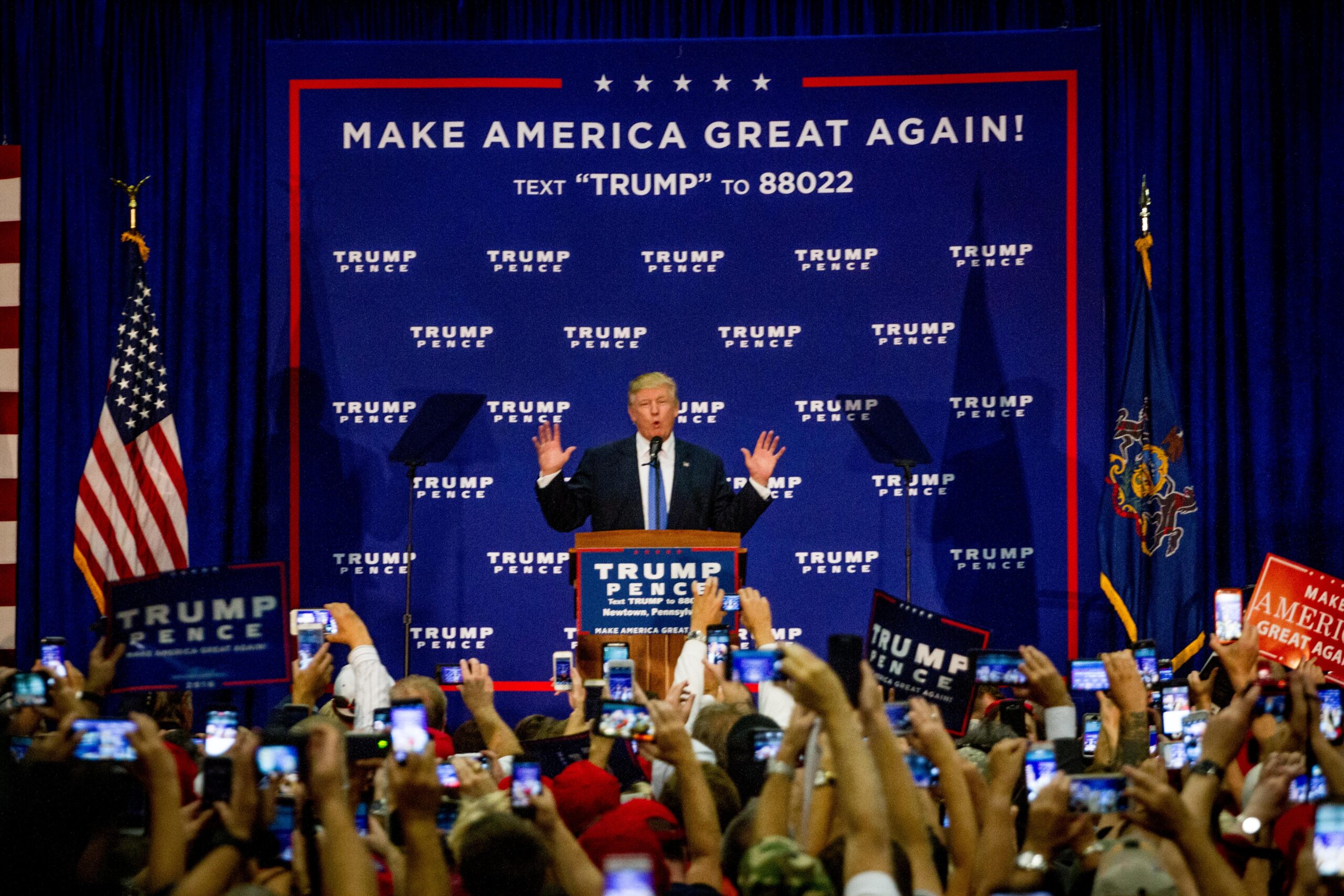
Throughout his campaign, Donald Trump promised to enforce America’s immigration laws, to end so-called “sanctuary cities,” which advertise themselves as safe havens for illegal aliens (though of course they do not call them “illegal aliens”), and to sharpen vetting procedures for people wishing to immigrate to America from countries known as sponsors of terrorism.
The President sometimes overstated and not infrequently misstated his case. Semantic precision is not a Trumpian speciality. But political effectiveness may be. Behind the Sturm und Drang that greeted Trump’s rhetoric on immigration, we can glimpse two very different concepts of the nation state and world order. One view sees the world as a collection of independent sovereign countries that, although interacting with one another, regard the care, safety, and prosperity of their own citizens as their first obligation. This is the traditional view of the nation state. It is also Donald Trump’s view. It is what licenses his talk of putting “America First,” a concept that, pace the anti-Trump media, has nothing to do with Charles Lindbergh’s isolationist movement of the late 1930s and everything to do with fostering a healthy sense of national identity and purpose.
The alternative view regards the nation state with suspicion as an atavistic form of political and social organization. The nation state might still be a practical necessity, but, the argument goes, it is a regrettable necessity inasmuch as it retards mankind’s emancipation from the parochial bonds of place and local allegiance. Ideally, according to this view, we are citizens of the world, not particular countries, and our fundamental obligation is to all mankind.
This is the progressive view. It has many progenitors and antecedents. But none is more influential than “Perpetual Peace: A Philosophical Sketch,” a brief essay that Immanuel Kant published in 1795 when he was seventy-one. The burden of the essay is to ask how perpetual peace might be obtained among states. The natural condition of mankind, Kant acknowledges, is war. But with the advent of “enlightened concepts of statecraft,” mankind, he suggests, may be able to transcend that unfortunate habit of making war and live in perpetual (ewigen) comity.
Kant lists various conditions for the initial establishment of peace—the eventual abolition of standing armies, for example—and a few conditions for its perpetuation: the extension of “universal hospitality” by nations was something that caught my eye. Ditto “world citizenship.” “The idea of . . . world citizenship,” he says at the end of the essay, “is no high-flown or exaggerated notion. It is a supplement to the unwritten code of the civil and international law, indispensable for the maintenance of the public human rights and hence also of perpetual peace.”
It is one thing to declare war illegal; it is quite another to enforce that edict.
Kant makes many observations along the way that will be balm to progressive hearts. He is against “the accumulation of treasure,” for example, because wealth is “a hindrance to perpetual peace.” By the same token, he believes that forbidding the system of international credit that the British empire employed “must be a preliminary article of perpetual peace.” Credit can be deployed to increase wealth, ergo it is suspect. Kant says that all states must be “republican” in organization. By that he means not that they must be democracies but only that the executive and legislative functions of the state be distinguished. (Indeed, he says that democracy, “properly speaking,” is “necessarily a despotism” because in it the executive and legislative functions of governments are both vested in one entity, “the people.”) He looks forward to the establishment of a “league of nations” (Völkerbund), all of which would freely embrace a republican form of government.
It would be hard to overstate the influence of Kant’s essay. It stands behind such progressive exfoliations as Woodrow Wilson’s “Fourteen Points,” not least the final point that looked forward to the establishment of a League of Nations. You can feel its pulse beating in the singing phrases of the 1928 Kellogg-Briand Pact, which outlawed war. It is worth noting that among the initial fifteen signatories of that noble-sounding pact, along with the United States, France, and England, were Germany, Italy, and Japan. What does that tell us about the folly of trusting paper proclamations not backed up by the authority of physical force? It is one thing to declare war illegal; it is quite another to enforce that edict.
Kant’s essay also directly inspired the architects of the United Nations and, in our own day, the architects of the European Union and the battalions of transnational progressives who jettison democracy for the sake of a more-or-less nebulous (but not therefore un-coercive) ideal of world citizenship.
I would not care to wager on how many of the hysterics who congregated at airports across the country to protest Donald Trump’s effort to make the citizens of this country safer were students of Kant. Doubtless very few. But all were his unwitting heirs. “Universal hospitality”: how the protestors would have liked that! (Though to be fair to Kant, he did note that such hospitality “is not the right to be a permanent visitor.”) I have no doubt that the motivation of the protestors had many sources. But to the extent that it was based on a political ideal (and not just partisan posturing or a grubby bid for notoriety and power), the spirit of Kant was hovering there in the background.
Kant was not without a sense of humor. He begins his essay by noting that he took his title from a sign outside a Dutch pub. “Pax Perpetua” read the sign, and below the lettering was the image of a graveyard. Perhaps the universal perpetuity of death is the only peace that mankind may really look forward to. Kant clearly wouldn’t agree, but it was charming of him to acknowledge that the idea of a genuine perpetual peace for mankind might be regarded by many as nothing more than a “sweet dream” of philosophers.
What has been called the populist spirit aims to rouse us from that “sweet dream”—what James Madison might have called the “theoretic” reverie of the meddling class whose designs for our salvation always seem to involve the extension of their own power and prerogative. In this sense, the issue of sovereignty also stands behind the debates over the relative advantages and moral weather of “globalism” vs. “nationalism”—a pair of terms almost as fraught as “democracy” and “populism”—as well as the correlative economic issues of underemployment and wage stagnation. “Theoretic” politicians may advocate “globalism” as a necessary condition for free trade. But the spirit of local control tempers the cosmopolitan project of a borderless world with a recognition that the nation state has been the best guarantor not only of sovereignty but also of broadly shared prosperity. What we might call the ideology of free trade—the globalist aspiration to transcend the impediments of national identity and control—is an abstraction that principally benefits its architects. As R. R. Reno, the editor of First Things, pointed out in a recent Op-Ed for The New York Times, “Globalism poses a threat to the future of democracy because it disenfranchises the vast majority and empowers a technocratic elite.”
In the end, what James Burnham described as the “managerial revolution” is part of a larger progressive project. The aim of this project is partly to emancipate mankind from such traditional sources of self-definition as national identity, religious affiliation, and specific cultural rootedness, partly to perpetuate and aggrandize the apparatus that oversees the resulting dissolution. Burnham castigates this hypertrophied form of liberalism (what we might call “illiberal liberalism”) as “an ideology of suicide” that has insinuated itself into the center of Western culture. He acknowledges that the proposition may sound hyperbolic. “Suicide,” he notes, may seem “too emotive a term, too negative and ‘bad.’ ” But it is part of the pathology that Burnham describes that such objections are “most often made most hotly by Westerners who hate their own civilization, readily excuse or even praise blows struck against it, and themselves lend a willing hand, frequently enough, to pulling it down.” The issue, Burnham saw, is that modern liberalism has equipped us with an ethic too abstract and empty to inspire real commitment. Modern liberalism, he writes,
does not offer ordinary men compelling motives for personal suffering, sacrifice, and death. There is no tragic dimension in its picture of the good life. Men become willing to endure, sacrifice, and die for God, for family, king, honor, country, from a sense of absolute duty or an exalted vision of the meaning of history. . . . And it is precisely these ideas and institutions that liberalism has criticized, attacked, and in part overthrown as superstitious, archaic, reactionary, and irrational. In their place liberalism proposes a set of pale and bloodless abstractions—pale and bloodless for the very reason that they have no roots in the past, in deep feeling and in suffering. Except for mercenaries, saints, and neurotics, no one is willing to sacrifice and die for progressive education, medicare, humanity in the abstract, the United Nations, and a ten percent rise in Social Security payments.
In his view, the primary function of liberalism was to “permit Western civilization to be reconciled to dissolution,” to view weakness, failure, even collapse not as a defeat but “as the transition to a new and higher order in which Mankind as a whole joins in a universal civilization that has risen above the parochial distinctions, divisions, and discriminations of the past.”
What has been called “populism” is a visceral reaction against these forces of dissolution.
Around the time that Donald Trump took office, his chief strategist Steve Bannon said that his goal was to “deconstruct the administrative state.” The phrase “administrative state”—also called “the regulatory state” or “the deep state”—has lately floated into common parlance. In The Administrative Threat, the legal scholar Philip Hamburger describes it as “a state within a state,” a sort of parallel legal and political structure populated by unelected bureaucrats. This amorphous congeries of agencies and regulations has become, Hamburger argues, “the dominant reality of American governance,” intruding everywhere into economic and social life.
What has been called “populism” is a visceral reaction against forces of dissolution.
Article I of the Constitution vests all legislative power in Congress, just as Article III vests all judicial authority in the Court. The administrative state is a mechanism for circumventing both. As such, Hamburger argues, the administrative state operates outside the Constitution.
When the Constitution places all legislative powers in Congress, it gives Congress not only the power to make law but also the power to unmake it. And it thereby bars the executive from suspending or dispensing with the law. When the Constitution, moreover, places the judicial power in the courts and guarantees the due process of law, it precludes the executive from telling the courts not to apply the law, and prevents the courts from abandoning their own judgment about what the law requires.
Binding citizens not through Congressionally enacted statutes but through the edicts of the managerial bureaucracy, the administrative state is “all about the evasion of governance through law, including an evasion of constitutional processes and procedural rights.” Accordingly, Hamburger concludes, the encroaching activity of the administrative state represents “the nation’s preeminent threat to civil liberties.”
Hamburger draws an analogy between the behavior of the administrative state and the behavior of such despotic monarchs as James I, Charles I, and James II. Instead of persuading Parliament to repeal or revise a statute, the British king simply evaded its force by decreeing that some or all of his subjects were not subject to its strictures. His power was absolute not merely in the sense that it was all but unlimited but also in the sense that it was independent or outside of the law. Students of Latin will recall the Ablative Absolute, a construction in which an ablative phrase is absolutum, “loosened” from or independent of the main clause of a sentence. Hamburger shows how the growth of the administrative state represents an extralegal “revival of absolute power” in this sense, one that threatens to transform Constitutional rights and guarantees into mere “options” that the government bestows or withholds at its pleasure. “The evasion,” he notes, “thereby changes the very nature of procedural rights. Such rights traditionally were assurances against the government. Now they are but one of the choices for government in its exercise of power. Though the government must respect these rights when it proceeds against Americans in court, it has the freedom to escape them by taking an administrative path.”
Just as British kings in the seventeenth century evaded Parliament through such expedients as the Star Chamber and the exercise of royal prerogatives and royal waivers—what John Adams castigated as “those badges of domination called prerogatives”—so the administrative state today operates in violation of the Constitution and beyond the authority of Congress. Barack Obama decreed that certain politically unpalatable provisions of the Affordable Care Act not be enforced, and presto, they were not enforced, even though they were the law of the land. He instructed his Department of Justice to intervene to prevent Arizona and other states from enforcing certain aspects of immigration law. He even forced public institutions to accommodate self-declared “transgender” persons in the toilets of their choice; he connived with lawsuits punishing bakers and Catholic hospitals and hobby shops who chose not to join this week’s politically correct campaign for the sexually exotic. The Constitution may have vested all legislative power in Congress and entrusted all judicial power to the courts, but the administrative state sidesteps those requirements by erecting a parallel bureaucratic structure of enforcement and control.
The administrative state today operates in violation of the Constitution.
“Eighteenth-century Americans,” Hamburger notes, “assumed that a rule could have the obligation of law only if it came from the constitutionally established legislature elected by the people.” Today, Americans find their lives directed by a jumble of agencies far removed from the legislature and staffed by bureaucrats who make and enforce a vast network of rules that govern nearly every aspect of our lives.
One of the most disturbing aspects of Hamburger’s analysis is the historical connection he exposes between the expansion of the franchise in the early twentieth century and the growth of administrative, that is to say, extra-legal, power. For the people in charge, equality of voting rights was one thing. They could live with that. But the tendency of newly enfranchised groups—the “bitter clingers” and “deplorables” of yore—to reject progressive initiatives was something else again. As Woodrow Wilson noted sadly, “The bulk of mankind is rigidly unphilosophical, and nowadays the bulk of mankind votes.” What to do?
The solution was to shift real power out of elected bodies and into the hands of the right sort of people, enlightened people, progressive people, people, that is to say, like Woodrow Wilson. Thus Wilson welcomed the advent of administrative power as a counterweight to encroaching democratization. And thus it was, as Hamburger points out, that we have seen a transfer of legislative power to the “knowledge class,” the managerial elite that James Burnham anatomized.
A closer look at the so-called “knowledge class” shows that what it knows best is how to preserve and extend its own privileges. Its activities are swaddled in do-gooder rhetoric about serving the public, looking after “the environment,” helping the disadvantaged, etc., but what they chiefly excel at is consolidating their own power.
In Thoughts on the Cause of the Present Discontents (1770), Edmund Burke criticized the Court of George III for circumventing Parliament and establishing by stealth what amounted to a new regime of royal prerogative and influence-peddling. It was not as patent as the swaggering courts of James I or Charles I. George and his courtiers maintained the appearance of parliamentary supremacy. But a closer look showed that the system was corrupt. “It was soon discovered,” Burke wrote with sly understatement, “that the forms of a free, and the ends of an arbitrary Government, were things not altogether incompatible.” That discovery stands behind the growth of the administrative state. Under the cloak of democratic institutions, its essentially undemocratic activities pursue an expansionist agenda that threatens liberty in the most comprehensive way, by circumventing the law.
At the same time, however, a growing recognition of the totalitarian goals of the administrative state has fed what many have called a populist uprising here and in Europe. “Populist” is one word for the phenomenon. An affirmation of sovereignty, underwritten by a passion for freedom, is another, possibly more accurate, phrase.
-
Thoughts on the Prosperity Reduction Act, with Assists from Sulla and Pompey the Great
Sometimes the transcriptions get garbled.
A few news outlets I saw recently carried stories about something they called the “Inflation Reduction Act.”
Some people laughed and pointed out that the name was a cruel joke.
Everyone who has attained the age of reason is worried about inflation. It’s the highest it’s been in 40-plus years.
So if you’re going to try to push through a $750 billion tax-and-spend bill along wholly partisan lines—the vote, after all, was 50–50, so Kamala Harris, as vice president, had to break the tie—you are well-advised to conceal the true nature of the beast.
Call it an “inflation reduction act” even if in committee everyone called it by its real name, the “prosperity reduction act.”
I wonder if any early drafts with that more accurate name survive. They would be collectors’ items.
But take a moment to ponder what just happened.
In some ways, it was like Obamacare, a huge, economy-threatening bill that, having passed with only one vote, was shoved down the throats of Americans as a partisan kick in the solar plexus.
It used to be that huge and destructive bills were passed with broad support.
Lyndon Johnson’s Great Society legislation may have been the most destructive suite of economy-crushing, government-expanding follies in American history.
But at least it was passed by a huge majority.
Today, we don’t do that.
Instead, we take our folly neat, in the most toxic and divisive form.
We double the size of the IRS, pump billions into counter-productive “green energy” initiatives, and raise taxes in the middle of a recession.
This is what the Democrats are touting as a “victory” for President Joe Biden.
And we don’t even try to compromise, to reach across aisles, because the other side aren’t fellow citizens who want what’s best for the country.
They are heretics and enemies who must be suppressed if not utterly destroyed.
That, anyway, seems to be the operational philosophy of the Democrats.
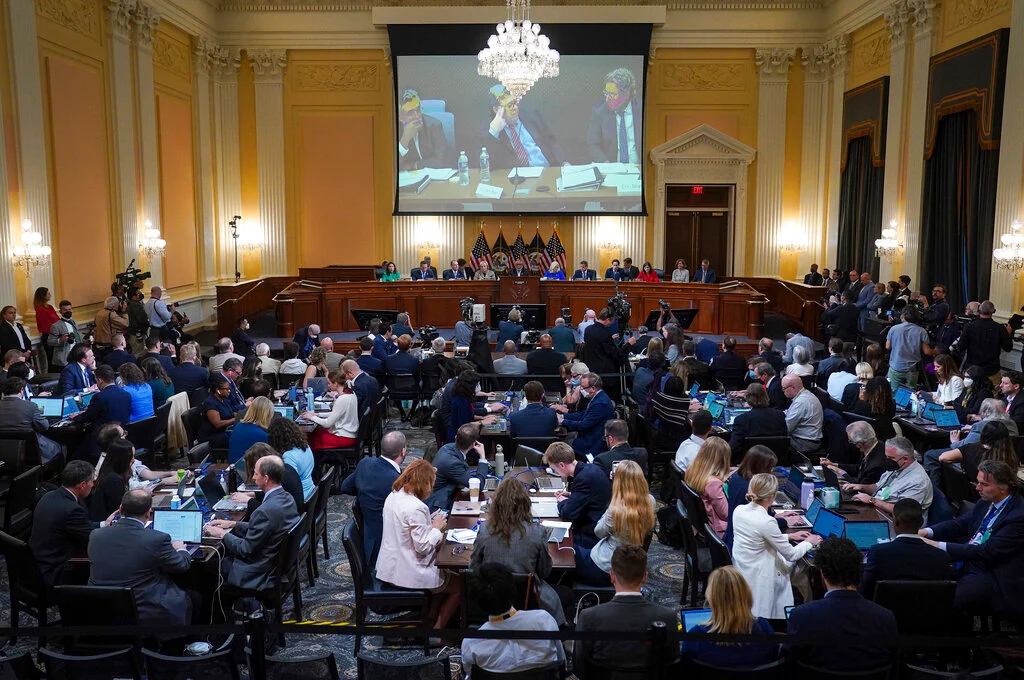
It’s also the operational philosophy of the anti-Trump brigades staffing the Committee of Public Safety, also known as the Jan. 6 committee, and its gigantic propaganda arm in the so-called mainstream media.
As Julie Kelly, Darren Beattie, and others have shown in meticulous detail, the entire Jan. 6 roadshow, beginning with the event itself and extending right up to the moment with the latest developments in Liz Cheney’s star-chamber-likeinquisition, has been an anti-populist campaign.
It’s an anti-Trump campaign, to be sure, but the animus is directed at something much larger than the once and possibly future president.
Cheney let some part of the truth slip a few days ago when she admitted that she would “find it very difficult” to support Florida Gov. Ron DeSantis for president in 2024.
She said it was because DeSantis “has lined himself up almost entirely with Donald Trump.”
But at bottom what bothers the future CNN hostess is not DeSantis’s allegiance to Trump per se, but rather his allegiance to the populist spirit he represents. It’s that which she finds “very dangerous.”
Not for the first time, I’m reminded of the actions of Lucius Cornelius Sulla, dictator of Rome for a couple of years around 82 B.C., and some of his allies.
It’s a complicated story, but the relevant episode concerns the struggle between the “optimates,” at whose head stood Sulla, and the “populares,” represented then by Gaius Marius.
When Sulla took Rome, one of his first actions was to draw up a proscription list of 1,500 Marian supporters.
These unfortunate people were subject to summary execution and had their property confiscated.
It’s in the nature of such ferocity to be inherently expansionist, like any government program, so that initial list of 1,500 soon encompassed more than 9,000.
In many cases, their only offense was having Marian sympathies, or having friends or relations who had Marian sympathies, or were seen walking in or about the Capitol in Washington on Jan. 6, 2021—wait, that last item is from a later iteration of Sullanian tyranny.
Two things stand out to me about the episode and remind me of our own campaign of proscription.
One is the construction of enemy lists mostly on the basis of what people believe and who they support, not, in most cases, on account of what they have done.
Part of this process is an ever-expanding definition of what is unacceptable.
Everyone is against terrorism and political extremism.
But what if “parading” at the Capitol is redefined as a form of “extremism” to be punished with years in prison?
Sulla’s proscription lists—rendering people outside the protection of the law because they support the other side—was one thing of which that anti-Trump war machine reminds me.
The other thing of which I was reminded was the behavior of the young Gnaeus Pompey when he was sent by Sulla to Sicily to deal with pockets of Marian resistance.
Pompey quickly ejected the Marians and set about restoring Sulla’s order.
In Messana, a group of Italian mercenaries called the Mamertines told Pompey that an ancient law limited his jurisdiction.
This seems to have been true.
But Pompey, in a move that Liz Cheney, Christopher Wray, and Adam Schiff would admire if they only knew about it, simply scoffed.
“Why,” he asked, “do you persist in talking about laws to us who have swords girt about us?”
Liz & Co. could have asked the same of Peter Navarro, John Eastman, or the hundreds of political prisoners languishing in the Washington gulag.
The vast majority are guilty of nothing more than being latter-day populares.
Sulla and his allies showed how dangerous being on the wrong side was for one’s health.
I don’t know if our Stasi, also known as the Federal Bureau of Investigation, hands out swords to its minions.
But troops in riot gear brandishing assault rifles and other firearms are just as effective. What Pompey wouldn’t have given to command Wray’s shock troops and Cheney’s subpoena power.
-
Thoughts on the Swamp
Where’s Cato the Elder when you need him?
Around 150 B.C., the grumpy Roman senator took to ending every speech, no matter what the topic (grain allotments for the plebs, plans for a new aqueduct, whatever) with the injunction “Ceterum autem censeo Carthaginem esse delendam”: “And another thing, I think that Carthage ought to be destroyed.”
That refrain has come down to us as a lapidary, three-word imperative: “Carthago delenda est”: “Carthage must be destroyed.”
Daniel Hannan, the British commentator, euroskeptic, and sometime member of the European Parliament, took a page from Cato’s book and for a time ended all his speeches with the formula “Pactio Olisipiensis censenda est”: “The Lisbon treaty must be put to the vote.”
There’s something to be said for repetition.
In 146 B.C., Rome besieged and then sacked Carthage. According to some accounts, the only thing left standing was a funerary monument.
The European Union is still moldering along, but at least the proximate goal of Hannan’s campaign, Britain’s exit from that soul-sucking leviathan, has been accomplished.
With those victories in mind, I’m thinking of concluding all my speeches with the phrase “Palus delenda est”: “The swamp must be destroyed.”
What’s the swamp?
The word has a long history, aided by the serendipitous contingency that Washington was actually built on a literal swamp.
But the term, like a Chinese virus, underwent a “gain-of-function” makeover in 2015 when Donald Trump first strode onto the center stage of American political life.
“The swamp” is the bureaucratic Washington establishment, the alphabet soup of agencies whose personnel, though unelected and largely unaccountable, run our lives right down to the latest permit, regulation, tax, fee, impost, and woke government requirement or interdiction.
But it’s also something more.
“The swamp” names an attitude, an assumption, about power, about politics, but also about certain basic human realities.
Above all, perhaps, “the swamp” rests and feeds upon the progressive assumption that the mass of citizens is incapable of self-government.
I call that assumption “progressive” because, from the time of Woodrow Wilson on down to the latest Davos mandarin, the neo-feudal bifurcation of humanity into the elect and (ever the majority) subservient has been the guiding, if unspoken, nutrient.
The litany of Trump’s policy achievements is long and distinguished.
It begins with his judicial appointments, some fruits of which we saw last month with the Supreme Court decisions on Roe v. Wade, the Environmental Protection Agency, and the Second Amendment, and includes his attention to our southern border, energy, taxes, the Middle East, and a host of other issues.
But more than any particular achievement, Trump was the tocsin that awakened millions of people—those whom Hillary Clinton dismissed as “deplorables”—to the two-tier reality of political life in the United States.
In “Nicomachean Ethics,” Aristotle wrote that “the good life of man” was the “end of the science of politics.”
Trump showed us how fond that idea had become.
In brief, Trump was the agent of a mass consciousness-raising.
It was that spectacle, the prospect of the people suddenly awakened to the reality not only of their bondage, but also to the identity of their putative masters that stood behind the astonishing hatred Trump aroused among the self-appointed elect.
The frenzied machinations of the Jan. 6 committee to destroy anyone and anything touched by the populist spirit Trump aroused show how desperate our rulers and their scribes and Pharisees have become.
They’re terrified lest Trump return to complete the task of (in Steve Bannon’s memorable phrase) “deconstructing the administrative state,” which the former president began in 2016.
Trump might not be the person capable of carrying that standard, but he is, despite all his quirks and crotchets, likely to be the most effective.
The fury unleashed against him will probably never end, although the midterm elections will probably deprive the rancid anti-Trump mafia of much of their armament.
The point is that the genie that Trump released won’t be coaxed back into the bottle.
Expect the anti-Trump furor to continue and grow in volume and vituperativeness.
Expect the population of the Washington gulag to swell with people indicted for “parading” in or around the Capitol.
Expect more dawn raids and unannounced arrests of former Trump associates.
We might even see the Jan. 6 committee making a criminal referral to the “Department of Injustice.”
The silver lining is that the more hysterical that agents of the regime become, the more stalwart will be the response of the newly awakened populace.
A reckoning, that is to say, is coming.
It can’t come too soon. In the meantime, join me in chanting “Palus delenda est.”
-
Time to Turn Orwell Into Fiction Again
Of all the creepy things that totalitarian regimes do, perhaps none is more creepy than their habit of encouraging children to inform on their parents to the regime.
Anyone who has read “1984“ will remember the pathetic Tom Parsons, who winds up next to Winston Smith in The Ministry of Truth (read: prison) after his young daughter reported that he had muttered “Down with Big Brother” in his sleep.
Parsons, besotted with the regime, is actually proud of his daughter’s initiative: “She listened at the keyhole. Heard what I was saying, and nipped off to the patrols the very next day. Pretty smart for a nipper of seven, eh?”
It’s too bad that the Biden administration disbanded the Disinformation Governance Board. Parsons would have fit in nicely there.
Maybe, as a temporary expedient, he could find a spot on Liz Cheney’s Jan. 6 House Select Committee. They’re filling special jails in Washington with people guilty of “parading” around the Capitol and uttering their support for Donald Trump.
True, Cheney is currently cleaning out her office in preparation for her trip to political irrelevance.
But after the Jan. 6 Committee is shut down come the new year and new Congress, people like Parsons will probably still be able to look to the so-called Department of Homeland Security (DHS).
For it turns out that the ominously named bureaucracy has taken “1984” as training.
The Biden administration may have had to shut down the preposterous Disinformation Governance Board after its head, Nina Jankowicz, made a fool of herself.
But its tasks of surveillance and suppression of opinions that dissent from the official narrative have been folded into the mandate of the DHS, a superfluous and increasingly malevolent agency that could have come straight out of the pages of Orwell.
An invaluable new watchdog group called The Foundation for Freedom Online has begun documenting efforts by the DHS to surveil and censor online speech in order to make it conform with narratives promulgated by the state.
What sorts of opinions are they censoring? Those regarding the CCP virus, the pathogen that causes COVID-19, for example. But it’s also censoring opinions about the protest at the Capitol on Jan. 6, 2021, as well as opinions about the integrity of the 2020 presidential election.
Doubts about that election are accumulating like barnacles on a rusted hulk at anchor, but you aren’t supposed to notice.
Whatever our masters in Washington want us to believe and parrot, there the DHS broods like a malevolent hen over your computer screen and social media accounts.
The latest revelation is that they’ve gone full Orwell, encouraging children who discover “wrongspeak” to report their misbehaving relatives to various tribunals.
In a new post, the Foundation for Freedom Online reveals that the DHS has instructed “children to report their own family members to Facebook for ‘disinformation’ if they challenge US government narratives on COVID-19.”
The Foundation for Freedom Online post includes links to a children’s cartoon that ends by recommending that “Uncle Steve” be reported for suggesting that “COVID-19 is no worse than the flu.”
Talk about creepy.
“DHS,” the Foundation for Freedom Online report reads, “chiefly spearheads censorship through its partnerships with tech companies, civil society groups, and media institutions, synchronizing a “whole-of-society” counter-disinformation networked response to collectively target the same narratives, the same slogans, the same symbols, the same influential movement voices, and the same highly engaged ‘repeat spreaders’ who comprise the narrative’s online support network.”
Remember, the DHS was created to help prevent another 9/11.
It has mutated into yet another governmental agency devoted to enforcing conformity and obedience among Americans.
The Foundation for Freedom Online noted that “DHS purports to distinguish between three types of speech violations: misinformation, disinformation, and malinformation.“
“Misinformation is a [sic] factually incorrect, but not on purpose. Disinformation is when someone lies on purpose, with a malevolent intent in advance. And malinformation is when someone’s opinion is factually accurate (or at least not provably wrong) but DHS determines the use of such facts to be misleading.”
The DHS is proposing to police it all.
As the Foundation for Freedom Online post notes, these distinctions are meant to give the impression to the outside world that the DHS proceeds deliberately and with restraint.
In practice, however, they fold “all their targets” into the category of “disinformation.”
The effect is to regard any dissenting opinion as a deliberate misrepresentation of the truth, punishable, in the first instance, by being banned from social media platforms.
Do you think that the 2020 election was problematic? Do you believe that Hunter Biden’s laptop is disturbing? You’re guilty of undermining “public trust” in government institutions and therefore must be denied access to Twitter, Facebook, and so forth.
The Foundation for Freedom Online has produced invaluable material on a major threat to U.S. freedom.
There’s more to come.
But what they’ve already reported shows that the “DHS’s new role, essentially, combines the foreign powers over speech and censorship granted to the CIA with the domestic reach of the FBI.”
Think about that.
For the first time in our history, we have the U.S. government deploying a sort of “domestic CIA” authorized to surveil and censor the “lawful speech of U.S. citizens, stopping them from talking freely about their own elections or criticizing their own democratic institutions.” It’s time to turn Orwell into fiction again.
-
Tolosa Winery: My Latest Discovery
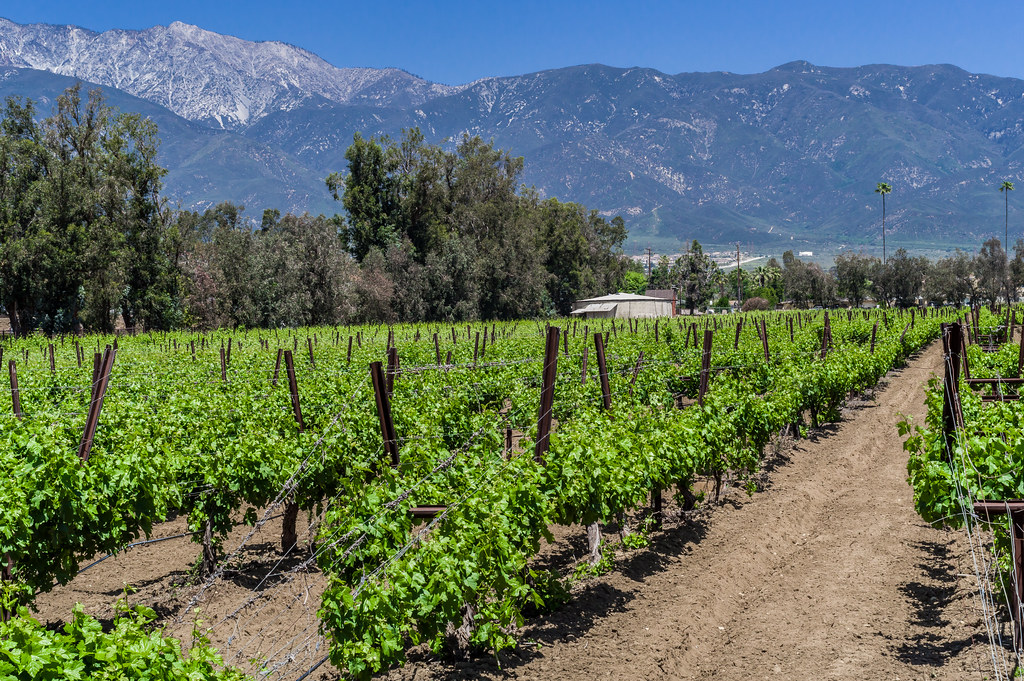
Writing about and — the necessary preliminary — drinking wine is a voyage of discovery. I won’t say that any new vineyard has made me feel quite like “stout Cortez” who, according to Keats, “star’d at the Pacific — and all his men/ Look’d at each other with a wild surmise—/ Silent, upon a peak in Darien.” But wine is in a deep sense about more than the fermented juice of the grape. It is about place — terroir, of course, but also place in a larger sense: place as habitation, place as community, which means place as the stage whereon manners, romance, technique and custom perform for the gods of pleasure. It is also about history and personality and their distillate: money, which ushers in snobbery and its accoutrements.
-
Tooting Your Own Horn
It appears that the Supreme Court of the United States is about to hear a case about honking horns.
The question at issue is whether state or local authorities may outlaw the honking of car horns when a person isn’t issuing a warning but registering an opinion, positive or negative, as the case may be.
It all began in 2017 when a driver honked her horn in order to show solidarity with some protesters outside the office of her local congressman.
A sheriff’s deputy was quickly on the spot to issue her a ticket for “illegal use of horn.”
Thus began the long trek to SCOTUS.
I have considerable sympathy for that deputy sheriff.
When TV screenwriters were on strike recently, a clump of them paraded and made a racket near my office in New York.
I didn’t much like that.
I liked it even less when my taxi driver, in response to signs bearing the legend “honk to support us,” repeatedly leaned on the instrument to declare his bona fides.
The Duke of Wellington is said to have disapproved of his men cheering because it seemed to him to come dangerously close to their expressing an opinion.
I know what he meant.
The people who are against laws banning honking horns in public to show one’s support (or, alternatively, to register one’s disapproval) say that it’s a matter of protecting free speech.
One might ask whether the First Amendment guarantees the right to make an audible nuisance of oneself.
I will leave the determination of that question to lawyers.
What immediately struck me about the case was how silly it seemed.
And it seems silly, I think, from opposite points of view.
Both parties to the horn-honking controversy are too promiscuous in their deployment of the law.
Those who want to outlaw honking car horns as an expression of opinion are too ready to employ the law to interdict something they dislike.
Those who want to be able to honk away whenever and wherever they please are ready to wrap themselves in the majesty of the First Amendment to protect indulging in their irritating habit.
This is where the Greek lawgiver Solon and the British jurist John Fletcher Moulton come in.
Solon thought that there should be very few laws, but that those few should be strictly enforced.
I would go further and suggest that, as a prophylactic against the overpopulation of laws, all laws should be automatically retired after a set period, three years, say, or five.
Those that, on mature consideration, are deemed to serve the public would be eligible for another term, but only after having run the gauntlet of legislative scrutiny.
That would be one blow against the waste, fraud, and abuse of laws.
Moulton articulated another in “Law and Manners,” a talk that he gave in the 1920s.
All social life, he observed, takes place on a spectrum between absolute freedom at one end and positive law at the other.
In some areas of life, we’re completely free to do whatever we like.
In others, we’re constrained by the coercive power of the state about what we must and must not do.
In between is a vast realm, more or less free, more or less restrained, governed not by law or by whim but by custom, manners, taste, and convention—the domain, Moulton said, of “obedience to the unenforceable.”
“The real greatness of a nation,” he said, “its true civilization, is measured by the extent of this land of obedience to the unenforceable. It measures the extent to which the nation trusts its citizens, and its area testifies to the way they behave in response to that trust.”
Already, in the 1920s, Moulton worried about the incursion on this intermediate realm of ordered liberty from increasing statism, on one side, and increasing anarchy, on the other.
Now, 100 years on, we have traveled far down that road.
The intermediate realm that Moulton praises has been further and further compressed.
This has tended to erase the critical difference between the idea that one can do something—i.e., that no law prohibits it—and that one may do it.
“There can,” Moulton observed, “be no more fatal error than this.
“Between ‘can do’ and ‘may do’ ought to exist the whole realm which recognizes the sway of duty, fairness, sympathy, taste, and all the other things that make life beautiful and society possible.”
Moulton understood how critical the extent and health of this realm is, especially to the success of democratic regimes.
“It is this confusion between ‘can do’ and ‘may do,’” he said, “which makes me fear at times lest in the future the worst tyranny will be found in democracies.”
Why? Because, Moulton observed: “Interests which are not strongly represented in parliament may be treated as though they had no rights by Governments who think that the power and the will to legislate amount to a justification of that legislation. Such a principle would be death to liberty. No part of our life would be secure from interference from without.”
When it comes to honking your horn, for example, should the law be involved on one side or the other?
Or should it be a matter of “obedience to the unenforceable,” a matter for manners, good taste, and a well-developed sense of the appropriate?
“If I were asked to define tyranny,” Moulton concluded, “I would say it was yielding to the lust of governing. It is only when Governments feel it an honorable duty not to step beyond that which was in reality, and not only in form, put into their hands that the world will know what true Freedom is.”
Tyranny as “the lust for governing.” There’s a lot to be said for that definition.
It’s especially pertinent in those societies, such as ours, where that lust is semi-concealed behind a scrim of aspiring legislators camouflaged as bureaucrats and public servants.
They tend to serve only themselves and are accountable not to any voters but merely to the apparatus they control.
I think people should be considerate about tooting their own horns. But I don’t see why the busybodies we allow to meddle in our affairs should be promulgating laws about it.
-
Truffle Shuffle
Regular readers may recall the trip we took to St. Émilion on the right bank of the Gironde-Dordogne river system a while back. It being truffle season, some enterprising chaps organized a dinner revolving around that delectable fungus and one of the very best wines from St. Émilion, Château Angélus, a Premier Grand Cru Classé A, and its second label, Carillon d’Angélus. Note the bell motif: a single bell features on the label of Château Angélus, three on that of Carillon d’Angélus, so named because in the vineyards one can hear the bells from three neighboring churches ringing out that prayer to Mary (Angelus Domini nuntiavit Mariæ…) in the morning, noon and around vespers.
-
Trump 2.0: A Shockwave of Change in Just Six Days
It’s almost as if elections have consequences. Donald Trump hasn’t been in office for a full week yet, but already the mood of the entire country seems to have undergone a beneficent metanoia. Sure, there have been hundreds of executive orders on matters large and small. There were many pardons, for 1500 people who engaged in that self-guided tour of the Capitol on January 6, 2021, and also for many others.
But it is more than that. In his first term, Trump endeavored to “drain the swamp” and counter the woke ideology that had infiltrated so many university campuses and government agencies. But Trump was a political greenhorn, surrounded by people who were not on board with his program. He said many of the right things. But in many cases when it came time to implement the policies he outlined, the message got lost or garbled in transmission.
-
Trump and the Relentless Momentum of Events
Harold Macmillan, prime minister of Great Britain from 1957 to 1963, was once asked by a journalist what was the most troubling problem he faced during his prime ministership. “Events, my dear boy, events,” was his reply.
-
Trump Found Guilty in America’s First-Ever Stalinist Trial
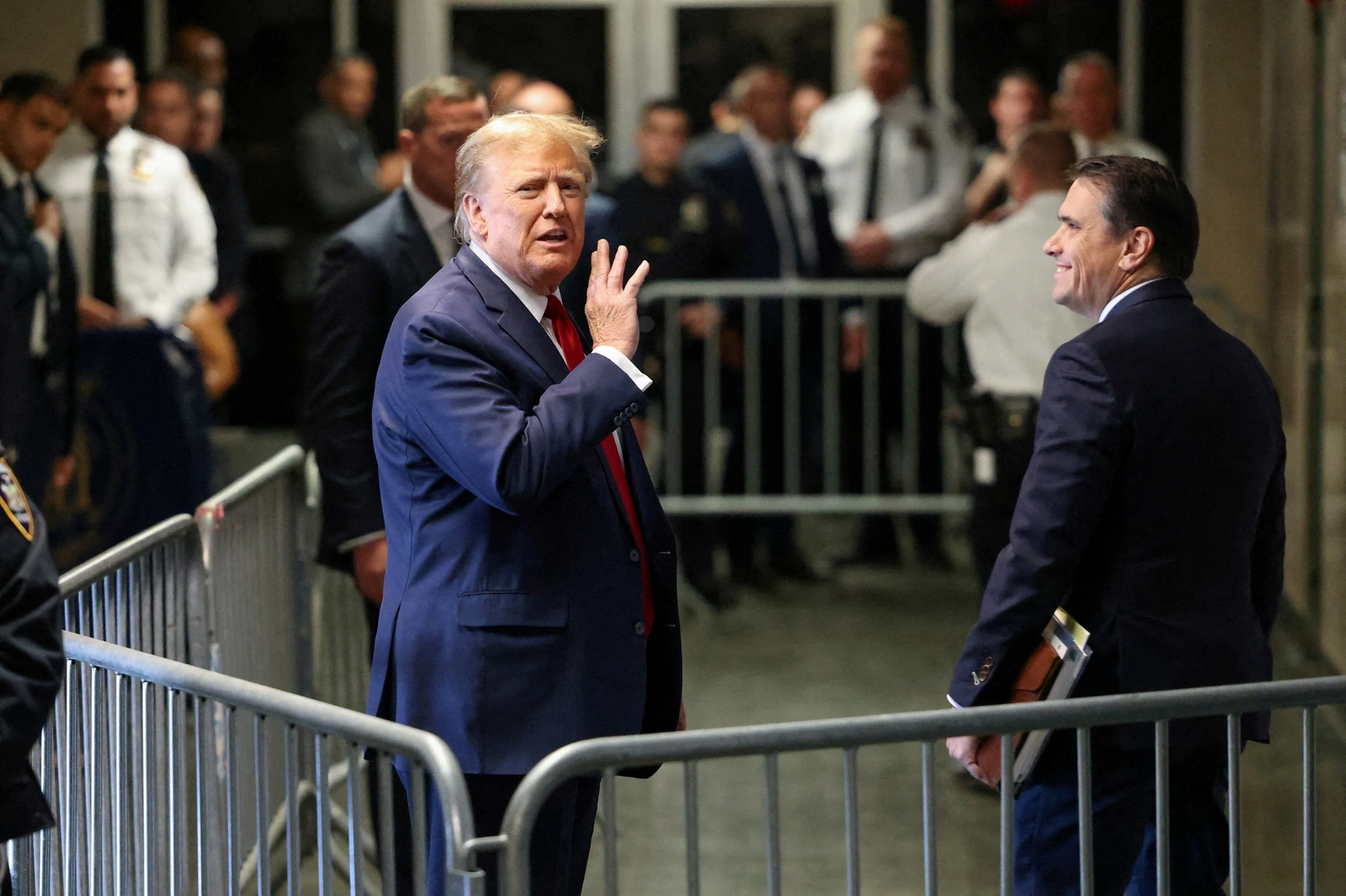
“What happens now?” That was the question flooding my inbox and what used to be called the Twittersphere. Why? Because shortly after 5 p.m. on May 30, Anno Domini 2024, the verdict in America’s first-ever Stalinist trial came down: Trump was guilty on all counts in the so-called “hush money trial” in New York.